Field Application
The last mile of composting: matching material to crop, soil, and season, so nutrients feed the plant instead of the waterway.
Calculating application rates
Rate decisions balance three things: crop nutrient need, soil-test phosphorus (the usual long-term cap), and soil organic matter goals. Start with the lab analysis of your compost — values on a wet-weight basis must be converted to the as-applied basis you spread.
Worked example
Compost analysis: 1.8% total N, 45% moisture. Target: 120 kg available N/ha for corn, assuming 30% of compost N mineralizes in year 1.
- Dry-matter N = 1.8% → wet-basis N = 1.8 × (1 − 0.45) = 0.99% N as-applied
- Available N = 0.99 × 0.30 = 0.30% → 3.0 kg N per tonne as-applied
- Rate = 120 ÷ 3.0 = 40 t/ha as-applied (≈18 t/acre) — a one-time soil-building rate
- Maintenance approach: supply 40–60 kg N/ha/yr from compost → ~13–20 t/ha/yr, topped up with other N sources
Always cross-check the phosphorus load: 40 t/ha adds substantial P₂O₅. Where soil-test P is already high or excessive, cut the rate and supply remaining N from other sources — or apply to meet P, not N.
Interactive application-rate calculator
Enter crop demand, soil-test phosphorus status, and your compost's lab analysis (dry basis). The calculator returns the rate to meet crop nitrogen and flags the phosphorus consequence.
Crop & soil
Compost analysis (dry basis)
Timing and placement
| Practice | Guidance | Why |
|---|---|---|
| Best window | Just before planting or during the main tillage pass; fall for spring crops on well-drained soils | Time for mineralization to meet crop uptake |
| Avoid | Frozen, snow-covered, saturated, or steep ground; 25 m+ setbacks from watercourses (more where required) | Runoff and leaching risk |
| Incorporate | Incorporate or shallow-inject within 24–48 h where possible | Cuts ammonia volatilization and runoff losses sharply |
| No-till surface | Surface applications work in no-till; expect slower N release and watch slugs/voles in heavy residue | Preserves soil biology and structure benefits |
| Raw-manure interval | NOP: 120 days before harvest of soil-contact crops (90 days for non-contact) if using raw manure — compost made to NOP standard is exempt | Food safety |
By cropping system
Row crops & cereals
Compost before the most responsive crop in the rotation (corn, potatoes, vegetables). Banding or in-row placement concentrates biology near seedlings at 1/3–1/2 the broadcast rate. Expect the strongest yield responses on sandy, low-OM, or degraded soils; on naturally high-OM prairie soils the response is often structural (water, trafficability) rather than nutritional.
Vegetables & intensive horticulture
Highest-value use. Typical rates 20–40 t/ha before heavy feeders; 10–20 t/ha for follow-on crops. For transplants, blend 10–30% screened compost into media (mind EC). Blended, pathogen-tested compost is essential for salad and baby-leaf crops — verify sanitation documentation.
Orchards & vineyards
Strip applications under the drip line at 10–30 t/ha, renewed every 1–3 years; composted mulch 5–10 cm deep suppresses weeds, moderates soil temperature, and feeds slowly. Time applications ahead of expected rain to wash nutrients in.
Pasture & forage
Surface-apply 10–20 t/ha on renewed or productive pastures; harrow to scatter lumps. Avoid applying to rested-for-grazing intervals shorter than local guidance (and keep raw manure/compost off pastures grazed by young stock where parasite carryover is a concern).
Container media & nurseries
Screened, mature, low-EC compost at 10–30% by volume in peat/bark blends. Test each batch for germination and EC — container systems amplify salt problems.
What compost actually supplies
| Nutrient | First-year availability | Notes |
|---|---|---|
| Nitrogen | ~10–40% | Slow-release over years; expect to supplement for high-N demand crops |
| Phosphorus | ~50–80% | Builds soil P steadily — the main reason to cap rates by soil test |
| Potassium | ~80–100% | Behaves close to mineral K |
| Calcium/Mg | High | Often underrated liming/conditioning value (compost pH 7–8) |
| Micronutrients | Broad spectrum | Chelated by humic substances, plant-available over time |
Spreader calibration: make the numbers real
A rate on paper means nothing until the spreader delivers it. Compost is the hardest material to meter accurately — wet, lumpy, variable-density — so calibrate by the catch-and-weigh method:
- Blank run: spread a known area (e.g., 50 m of a 3 m swath = 150 m²) at your normal gear setting and PTO speed with an empty bed to find the practical low/medium/high.
- Calibration run: load a known weight (weigh the bed, spread, re-weigh), run the same distance, collect the delta.
- Convert: kg delivered ÷ area (m²) × 10,000 = t/ha. Compare to target; adjust the gate/chain speed and repeat until within ±10%.
- Reality check on the ground: lay bucket-lines every 20 m, run a pass, and weigh catch buckets — swath distribution matters as much as total rate, especially for banded work.
- Re-calibrate: every time moisture, screen size, or model of compost changes — a wet spring batch delivers 30–50% more wet mass per gate setting than a dry, screened batch.
Three worked examples
1. Vegetable field — nitrogen-based
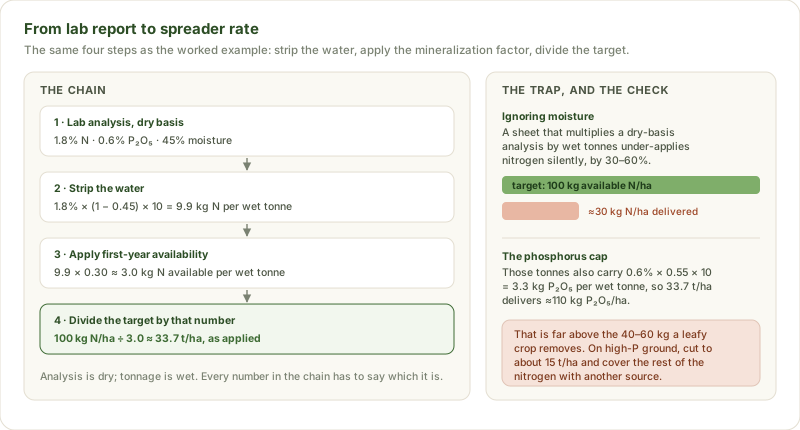
Compost analysis on the dry basis a lab reports: 1.8% N, 0.6% P₂O₅, 45% moisture, 30% yr-1 mineralization. Target 100 kg available N/ha.
N per wet tonne = 1.8% × (1 − 0.45) × 10 = 9.9 kg N/t; available in year 1 = 9.9 × 0.30 ≈ 3.0 kg N/t → rate = 100 ÷ 3.0 ≈ 33.7 t/ha as-applied (≈18.5 t dry matter/ha). P check: 0.6% × 0.55 × 10 = 3.3 kg P₂O₅/t → ~110 kg P₂O₅/ha, above a leafy-crop removal of ~40–60; on high-P soil cut to ~15 t/ha and top N with another source.
A richer 2.5%-N compost hits the same 100 kg N/ha at ≈22 t/ha — which is why the analysis, not the tonnage, sets the rate. The calculator above does this arithmetic, including the moisture conversion.
2. Perennial orchard — soil-building, P-balanced
Compost at 0.4% P₂O₅ (dry basis), 45% moisture. Target P₂O₅ 40 kg/ha (tree removal + maintenance). P₂O₅ per wet tonne = 0.4% × 0.55 × 10 = 2.2 kg → rate = 40 ÷ 2.2 ≈ 18 t/ha, banded under the drip line, every 2 years. N contribution (~1.0% N dry × 0.55 × 10 = 5.5 kg N/t wet × 30% ≈ 1.7 kg N/t → ~30 kg N/ha) is comfortably covered by the orchard N budget.
3. One-time degraded-soil remediation
Compacted construction-grade soil, OM ≈ 0.5%. Apply a one-time 75 t/ha screened compost incorporated full-depth with deep tillage, then a cover crop. Document pre- and post- (see measuring soil health) — expect the biggest response in years 2–4 as OM, biology, and water interact. Reserve such rates for genuine remediation, not routine fertility.
Cautions and rate limits
- Phosphorus accumulation: the binding constraint on annual composting. Track soil-test P; switch to "apply-to-P" logic once agronomic P is exceeded.
- Salts (EC): manure/food-waste composts can injure seedlings at high rates in dry climates or containers. Leach with irrigation or reduce rates.
- Nitrogen tie-up: applying high-C:N (>25:1) or immature compost can immobilize soil N for weeks. Only apply compost with finished C:N ≤20:1.
- Herbicide carryover: the persistent-pyralid herbicides (see Feedstocks) show up as crop injury after compost — bioassay unknown batches.
- Food-safety intervals: for produce-market crops, follow GAPs and FSMA Produce Safety Rule requirements for soil amendments of animal origin, and document sanitation (see Standards).
Documentation for nutrient management
Most nutrient-management programs expect: compost analysis per source, application rate and date, field, crop, incorporation method, and — for organic certification — process documentation (time–temperature logs and turnings) demonstrating NOP-compliant production. Keep these with your manure/compost plan; they also anchor cost-share applications.