The Science of Composting
Composting is a managed microbial succession. Understanding who the decomposers are, what they eat, and how temperature reshapes the community is the foundation of every practical decision on the farm.
What decomposition actually is
Decomposition is extracellular digestion carried out by microorganisms. Because microbes cannot eat a particle whole, they secrete enzymes — cellulases, proteases, lipases, lignin peroxidases — into the material around them, break polymers into soluble fragments, and absorb those fragments. The heat of a compost pile is a byproduct of that metabolism: microbial respiration releasing energy as chemical bonds are oxidized.
A compost pile is therefore an engineered habitat. Your job as its manager is to keep four variables in the growth window for the right microbes at the right time: oxygen, moisture, nutrition (C:N), and temperature. Get those right and sanitation, speed, and odor control follow automatically.
The four phases of hot composting
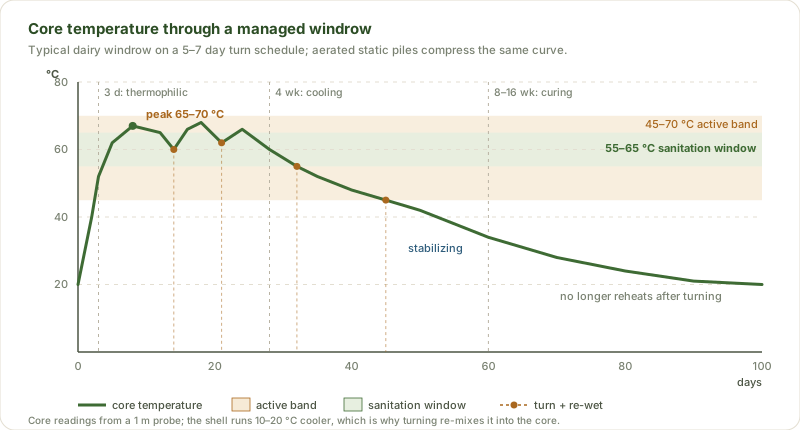
Monitor any well-built pile and you will observe a predictable thermal and biological sequence. Times below are typical for a well-managed windrow; aerated systems compress them.
| Phase | Temperature | Dominant organisms | Dominant processes | Manager's task |
|---|---|---|---|---|
| Mesophilic | 10–40 °C | Mesophilic bacteria | Soluble compound metabolism, rapid growth | Ensure mix & moisture are right at build |
| Thermophilic | 45–70 °C | Bacillus, Thermus, actinomycetes | Protein/fat/hemicellulose breakdown; sanitation | Turn or aerate to keep O₂ >5%; hold 55 °C+ |
| Cooling | 45–25 °C falling | Actinomycetes, fungi return | Cellulose & lignin attack; stabilization | Reduce turning frequency; watch moisture |
| Curing | Near ambient | Soil-like community, mites, worms | Humification, detoxification | Keep moist & aerated; test before use |
| Temperatures are pile core values. Duration varies with feedstock, season, and system. | ||||
The decomposer community
Bacteria — the volume workers
Bacteria dominate numbers and early activity. Key groups include Pseudomonas and Bacillus (versatile, spore-forming thermophiles), Thermus, Thermomonospora, and Actinobacillus. They excel at moist, water-film environments, preferentially consume proteins and soluble carbohydrates, and include the primary thermophiles that generate and tolerate 60 °C+ conditions.
Actinomycetes — the tough-stuff specialists
Morphologically filamentous bacteria, actinomycetes such as Streptomyces and Thermomonospora colonize specific substrates — chitin (insect and fungal cell walls), lignin-hardened tissues, and recalcitrant cellulose. They produce geosmin, the source of compost's characteristic earthy smell, and are most visible during cooling as whitish patches in hot pockets.
Fungi — the lignin engineers
Fungi dominate later stages and cooler zones. White-rot and brown-rot basidiomycetes degrade lignin, opening up wood-based feedstocks that bacteria cannot touch; their hyphae also physically translocate nutrients and water through the pile. Because most fungi are killed above ~60 °C, they recolonize from margins during cooling — one reason curing matters for quality.
The micro-fauna
Protozoa, nematodes, mites, rotifers, and (in cool piles) earthworms graze on bacteria and fungi, releasing locked-up nitrogen (the "microbial loop"), dispersing spores, and physically fragmenting particles. Their activity signals a maturing, soil-like ecosystem — a hallmark of well-cured compost.
Carbon:nitrogen chemistry
Microbial biomass is built at roughly 30:1 C:N (bacteria ~4–5:1 in their own tissue, but their growth efficiency on mixed substrates demands a substrate near 25–30:1). The initial mix dictates the whole game:
| Initial mix C:N | Microbial response | Compost signal |
|---|---|---|
| Below ~20:1 | Excess N beyond microbial demand | Ammonia odor, N loss as NH₃, pH rise |
| 25:1–35:1 | Balanced — C and N consumed together | Rapid heating, minimal odor, efficient N retention |
| Above ~40:1 (carbon-rich, N-limited) | Slow start; microbes scavenge N; long process | Pile cools early, stays cool; may rob soil N if applied immature |
During composting the mix C:N falls over time — carbon leaves as CO₂ much faster than nitrogen leaves as gas — typically converging toward 10:1–20:1 in finished compost. A finished C:N of ≤20:1 (some standards say ≤15:1) avoids nitrogen immobilization in soil.
Mass & moisture accounting
Every farm manager eventually asks: what does a tonne of feedstock become? The answer runs on two conservation laws — dry matter and water — and it explains most recipe math, transport economics, and settlement claims.
- Dry-matter (carbon) loss: 40–70% of the initial dry matter is respired to CO₂ and water during active composting. Nitrogen and mineral matter do not leave with it — they concentrate — which is why finished compost has a higher nutrient and ash percentage than the feedstock.
- Mass loss overall: wet weight typically falls 30–60% (dry loss + moisture evaporation). A quick planning rule: ~2–3 wet tonnes of typical manure feedstock become ~1 wet tonne of finished compost.
- Volume loss: 40–60% (denser material as structure collapses). This math sets pad area, windrow rebuild intervals, and storage requirements.
- Moisture is moving target: hot piles lose water rapidly (often 10–30 percentage points), so final product moisture is your lever — re-wet at turning for process; let it dry at the end for transport economics.
- Salt- and metal-enrichment caution: because mass leaves, applied compost concentrates whatever came in — salts, heavy metals, PFAS. Feedstock quality compounds through the process (see contaminants).
Working example: 10 t of dairy slurry at 90% moisture = 1 t dry matter + 9 t water. Composted to 45% moisture and 50% dry-matter loss, the remaining 0.5 t dry matter at 55% dry content = ≈0.9 t of product — a roughly 11:1 shrink, which is why hauling raw water to market never makes sense, and why economics so often decides the method.
Heat, energy, and temperature management
Aerobic respiration of carbohydrate releases roughly 14–18 kJ per gram of substrate metabolized; a dense, well-insulated pile can exceed 80 °C if unmanaged. That heat is a tool:
- Sanitation: pathogen and weed-seed kill follows time × temperature. At 55 °C, Salmonella and E. coli die within days; Ascaris ova need sustained heat; most weed seeds die at 55–60 °C for 3 days.
- Rate: decomposition rate roughly doubles per 10 °C rise within the biological range — until enzymes denature above ~70–75 °C, when the pile "flashes" then stalls.
- Drying: hot piles evaporate water rapidly (often 10–30 percentage points of moisture over the active phase), which is why moisture must be re-added at turning.
- Self-limiting risk: above ~71 °C (160 °F), microbial activity declines and spontaneous combustion becomes possible in huge, dry, compacted piles — rare but real in commercial yards.
Compost vs raw manure vs synthetic fertilizer
All three are valid tools; they answer different questions. The comparison that actually matters on a farm is usually compost vs raw manure (both are on-farm organics) — synthetic fertilizer is orthogonal and complements both.
| Compost | Raw manure | Synthetic fertilizer | |
|---|---|---|---|
| Organic matter delivery | High, humus-rich, stable | Moderate | None |
| Nitrogen timing | Slow, mineralized over years (10–40% yr 1) | Fast — largely plant-available immediately; loss-prone | Immediate and tunable (also slow-release forms) |
| Phosphorus | ~50–80% available, builds soil P | High availability, high load per tonne | Fully available; choose timing/rate |
| Pathogens / weed seeds | Reduced by process (if heated) | Present | None |
| Odor & handling | Mild, stable, stackable, transportable | Strong, bulky, wet (hauling water) | Clean |
| Biology (microbes, disease suppression) | Rich, documented | Present, variable | None (can suppress some microbial function at high rates) |
| Soil structure & water | Strong, compounding | Moderate | None |
| Cost per unit N/P | High | Low | Very low (but lifecycle emissions higher) |
| Nitrogen loss potential after application | Low (slow release) | High (volatilization, runoff, leaching) | Moderate (dependent on timing/placement) |
Typical strategy: compost (or well-stocked manure) supplies the soil biology, organic matter, P, K, and a slow N base; synthetic N tops up peak crop demand; raw manure covers immediate N where permitted and odor is tolerable. The mix is a local decision — economics in the Economics chapter, fertility logic in Field Application.
Humus, humic substances, and the end product
As composting proceeds, a fraction of carbon is transformed into humic substances: large, complex, aromatic polymers built partly from lignin-derived phenols, partly from microbial cell-wall residues. These give finished compost its dark color, high cation exchange capacity, and longevity in soil. A useful mental model:
- Humic acid — larger molecules, soluble in alkali; dominate CEC and dark color.
- Fulvic acid — smaller, soluble at any pH; more bioactive, chelates nutrients.
- Humin — the insoluble fraction, tightly bound to minerals; very stable.
- Humic substances build gradually; longer composting and curing increases their share of total carbon.
Compost's value in soil comes from all three mechanisms: nutrients (N-P-K, Ca, Mg, S, micronutrients, released slowly), physical improvement (aggregation, infiltration, water holding), and biology (microbial inoculum, enzyme activity, and the disease-suppressive effects described in Soil & Agronomic Benefits).