Quality & Standards
"Finished" is a measurable state, not an appearance. Quality has four dimensions — maturity, stability, cleanliness, and safety — each with its own tests and standards.
The four dimensions of quality
🧪 Stability
Is decomposition substantially finished?
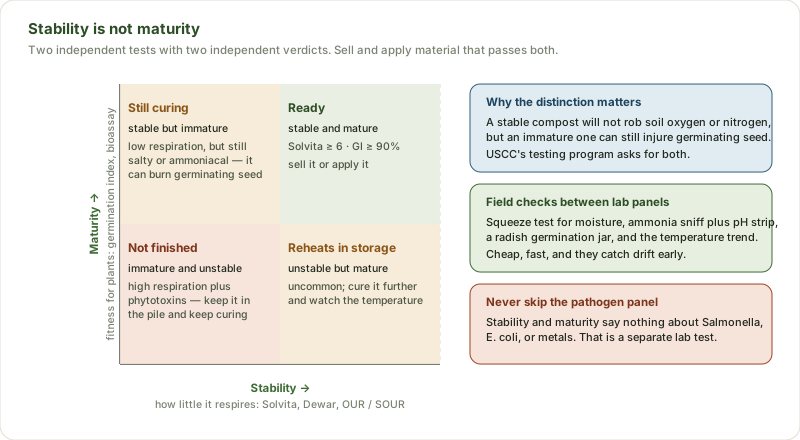
Measured as respiration (CO₂ evolution or O₂ uptake). Unstable compost reheats in storage, robs soil of oxygen and nitrogen, and can carry odor. Measured by: Solvita, Dewar self-heating, OUR/SOUR labs.
🌱 Maturity
Is it safe for plants and seeds?
A mature compost is non-phytotoxic and supports germination and root growth. Immature compost carries ammonia, organic acids, and high salts that injure seedlings. Measured by: germination index, seedling emergence, plant bioassays.
🧹 Cleanliness
What else came in with the feedstock?
Physical contaminants (plastic, glass, metal), stones, and heavy metals (Pb, Cd, As, Ni) reflect feedstock control. Measured by: man-made inert sampling and metals panel.
🦠 Safety
Pathogen and vector attraction status.
Fecal indicator bacteria (fecal coliform, Salmonella) and helminth ova, reduced through sustained thermophilic exposure. Measured by: lab pathogen panel; process-monitored via time–temperature logs.
Stability tests
| Test | Method | Typical "stable" threshold | Cost/effort |
|---|---|---|---|
| Solvita CO₂ burst | Colorimetric paddle in sealed jar, 4–24 h | Index ≥ 6 of 8 | $ low, field-ready |
| Dewar self-heating | Insulated flask, max temp rise over 5–10 d | Rise ≤ 10–20 °C | $ low, slow |
| OUR / SOUR (TMECC) | Lab O₂ uptake on re-wetted sample | e.g., ≤ 2–4 mg O₂/g VS/h (method-specific) | $$ lab |
| Respirometry (CO₂ CER) | Lab CO₂ rate per g dry solids | e.g., ≤ 2–5 mg CO₂-C/g/day | $$ lab |
Maturity tests
- Germination index (cress or radish): extract compost in water, germinate seeds in the extract, score germination % × root length % vs control. GI ≥ 90% = mature; 80–90% acceptable for many uses; <80% not for seedlings or sensitive crops.
- Seedling emergence & growth trials: potting-mix blends (e.g., 25/50/75% compost) grown for 2–3 weeks; the practical "grow test."
- NH₄⁺ : NO₃⁻ ratio: immature compost is ammonium-dominated; a ratio < ~0.5–1 (nitrate overtaking ammonium) indicates maturity. Useful free signal in standard nutrient panels.
Pathogens & sanitation
Composting's sanitation power comes from sustained heat, not a momentary spike. Time × temperature at the coldest point of the pile determines kill:
| Organism | Approx. thermal death (indicative) |
|---|---|
| Salmonella spp. | ~55 °C for hours–days; 60 °C kills in minutes–hours |
| E. coli O157:H7 | Similar to Salmonella; sensitive to sustained 55 °C+ |
| Listeria monocytogenes | Reduced at 55–60 °C; regrowth risk if re-contaminated when cooling |
| Ascaris (helminth) ova | Among the most heat-resistant: needs sustained ~55 °C for days |
| Most plant viruses & clubroot (Plasmodiophora) | Partially resistant; some survive normal composting — crop-rotation hygiene still matters |
| Weed seeds | Most die at 55–60 °C for 3+ days; some hard-coated species are more resistant |
Heavy metals, physical contaminants, and emerging concerns
Heavy metals
Metals concentrate because carbon mass leaves as CO₂ while metals stay ("enrichment factor" ~1.5–3×). Feedstock control is everything: biosolids and industrial byproducts carry the highest loads; yard and crop feedstocks the lowest.
Physical contaminants
Film plastic, glass shards, and microplastics are the most visible quality complaint in compost from mixed municipal feedstocks. Screening (typically 6–12 mm for landscape/agronomic grade) removes coarse particles; sourcing clean feedstocks is the only real fix for fines.
Persistent herbicides & PFAS
See Feedstocks: aminopyralid-family herbicides survive composting and damage sensitive crops; PFAS enters mainly via biosolids and food-contact materials. Bioassay suspicious inputs; document feedstock sources for high-value markets.
Getting a lab test
- Sample correctly: take 5–10 subsamples from recently turned, mixed material across the whole pile (not the surface), combine ~1 L, double-bag, keep cool, ship fast. Test Methods for the Examination of Composting and Compost (TMECC) protocols govern accredited labs.
- Choose the panel: for agronomic use: nutrients (total N, P₂O₅, K₂O, Ca, Mg, S + micros), moisture, pH, soluble salts (EC), organic matter, C:N. Add maturity/stability (Solvita or lab respiration) and pathogen panel for sale or sensitive crops.
- Frequency: annually per product line at minimum; more often when feedstock mix changes or for nutrient-management-plan documentation.
In-process field tests (between lab dates)
Between annual lab panels, these field checks keep you honest:
- Temperature trend: core temp for both sanity and sanitation documentation (see Process Control).
- Moisture squeeze test: 10-second gate before any lot change (targets in moisture).
- Ammonia sniff + pH strip: rising ammonia smell while pH climbs above ~8 flags an N-rich batch heading into storage.
- Screen-and-look gate: before any product ships, hand-sort a shovelful — plastics, glass, and gravel are caught here or they ship (the full gate check in Screening, Finishing & Storage).
- Germination mini-test: 10 radish seeds on damp compost in a jar, 5–7 days — a crude but real maturity screen between lab runs.
- Observation log: appearance, odor class, worm/insect activity, dust — the subjective channel that catches problems before instruments do.
Field tests never replace lab panels (they can't catch metals or pathogens) — they compress the interval between them and catch gross drift in time.
Heavy metals: limits you'll meet
If you sell compost or receive biosolids-derived material, you'll meet numeric metal ceilings. Published limits differ by jurisdiction and product class — the table below gives commonly cited reference ceilings (mg/kg dry weight) for comparably strict classes (US EPA Class A Exceptional Quality, EU Class A-style, PAS 100, Canadian Category A). Always verify current values for your jurisdiction — these are reference ranges, not your permit sheet.
| Metal | US EPA EQ (sludge) | EU (indicative A) | PAS 100 (UK) | Canada Cat. A |
|---|---|---|---|---|
| As | 41 | 10 | 25 | 13 |
| Cd | 39 | 0.7–1.5 | 1.5 | 3 |
| Cr | 1,200 (total) | 70–100 | 100 | 210 |
| Cu | 1,500 | 70–200 | 200 | 400 |
| Hg | 17 | 0.4–1 | 1 | 0.8 |
| Ni | 420 | 25–50 | 50 | 62 |
| Pb | 300 | 45–120 | 200 | 150 |
| Zn | 2,800 | 200–400 | 400 | 700 |
Values are indicative reference ceilings drawn from public standards (40 CFR 503 Table 3, EU 2019/1009 module, PAS 100:2018, CCME Category A) — ranges reflect intra-jurisdiction product classes. They are educational context, not regulatory guidance: obtain your governing standard's tables when making product decisions.
Reading a compost analysis sheet
| Parameter | Typical good compost | What it means |
|---|---|---|
| Moisture | 30–50% | Handling, transport value; too wet = shipping water |
| Organic matter | 30–50% of dry wt | Core value proposition |
| C:N ratio | ≤ 20:1 (ideally 10–15:1) | Above ~25:1 risks N tie-up in soil |
| Total N | 1–2.5% (dry) | ~10–40% mineralizes in year 1 |
| pH | 6.5–8.0 | Above 8.0: watch lime-sensitive crops |
| EC (soluble salts) | 2–6 mmhos/cm | High values restrict container use |
| Solvita / respiration | Index 6–8 | Stability — won't reheat or rob soil O₂ |
| Germination index | ≥ 90% | Maturity — safe for seedlings |
| Fecal coliform | < 1,000 MPN/g (Class A-equivalent) | Sanitation |
| Salmonella | Not detected /3 <3 MPN/4g | Sanitation |
Standards & regulatory frameworks
| Framework | Jurisdiction | Core process requirement | Core product limits |
|---|---|---|---|
| EPA 503 PFRP (biosolids compost) | US, sludge-derived | 55 °C × 3 d (in-vessel/ASP) or 55 °C × 15 d with 5 turns (windrow) | Fecal coliform <1,000 MPN/g; Salmonella <3 MPN/4g; metals (Ceiling/PCL) |
| NOP (US organic) | US, certified-organic inputs | Raw-manure compost: initial C:N 25:1–40:1; 55–77 °C for 15 d with ≥5 turnings (or ASP equivalent) | Feedstock rules (no biosolids, no synthetic ingredients); applied fertility still must meet nutrient accounting |
| EU Fertilising Products Regulation + national end-of-waste | EU | National process rules (commonly ≥60–65 °C hygiene phase) | National limits on metals, impurities, stability (e.g., oxygen uptake) |
| PAS 100 + BSI kitemark | UK | Min 60 °C hygiene phase with defined turn/aeration regime | Pathogens, metals, stones, glass, plastic limits; market-grade specs |
| USCC STA (Seal of Testing Assurance) | US, voluntary | n/a (product labeling program) | TMECC-method testing + content claim disclosure |
| Canada BNQ / CCME | Canada | Process + product criteria by category (AA, A, B) | Metals, pathogens, maturity |
Also relevant: US EPA 503 Class B pathogen alternatives for manure-based (non-biosolids) compost are often adopted voluntarily or via state rules; many states regulate composting facilities by tonnage, feedstock, and setbacks rather than product standards.