Methods & Systems
The biology is identical everywhere; the engineering differs. Choose the smallest system that meets your sanitation, odor, land, and labor constraints.
Choosing a system
Five questions define the choice: (1) How much material per week? (2) What feedstock — wet manure, food scraps, dry residues? (3) What odor, vector, and neighbor constraints? (4) How much pad and equipment do you have? (5) What product quality or certification do you need? The table at the bottom summarizes trade-offs; the sections below give design detail.
Turned windrow
Long triangular or trapezoidal piles turned by loader or windrow turner. The default for on-farm manure composting: low capital, forgiving of recipe variation; weather-exposed and odor-releasing at each turn.
Design parameters
- Height 1.5–3 m, width 3–5 m at the base; peaks above ~3 m limit natural convection
- Any length that suits the pad and loader
- Spacing: ≥3 m between rows for equipment access
- Base: compacted all-weather pad with 2–4% slope for leachate control
Typical turning schedule
- Turn when core temperature peaks and begins to fall, or when O₂ falls below ~5%
- Move material outside-in and bottom-top so everything re-enters the hot core
- First 4 weeks: every 7–10 days; weeks 5–8: every 2–3 weeks; then as needed
- Re-wet during turning if moisture has fallen below ~45%
Aerated static pile (ASP)
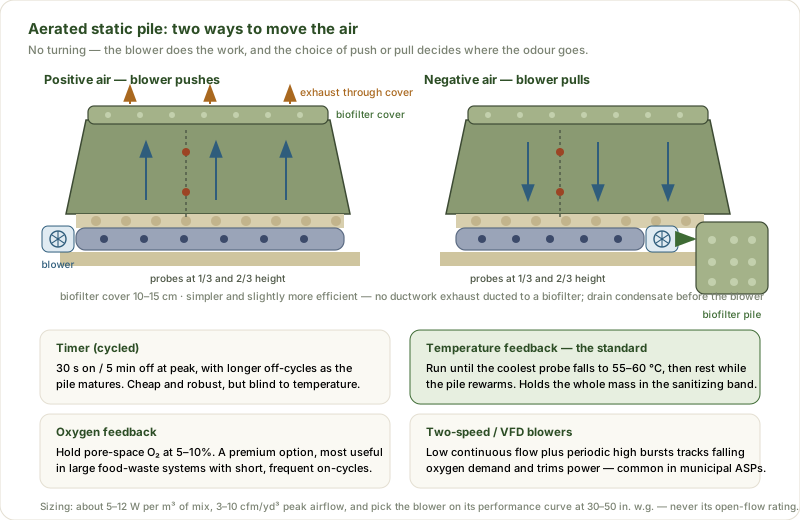
No turning. Material is built over perforated pipe on a pad; a blower (pushing or pulling) forces air through the mix, usually temperature-feedback controlled — the blower runs until pile temperature falls below setpoint, then rests. Dense, wet, or odorous feedstocks (food scraps, separated digestate solids) work here where they would fail in a windrow.
Key elements
- Perforated pipe laterals on the pad, spaced 1–2 m apart
- 5–15 cm pipe-bedding plenum of coarse chips under the mix
- 10–15 cm biofilter cover of screened finished compost
- Temperature probes at 1/3 and 2/3 height in two or more locations
- Timer or temperature-feedback blower control
Strengths & limits
- No turning labor; smaller footprint; odors captured (negative-air systems pull exhaust through a biofilter)
- Standard sanitation: 55 °C for 3 days all-through (PFRP-equivalent for in-vessel/ASP)
- Blower sizing rule of thumb: roughly 5–12 W per m³ of mix for manure/food-waste ASPs
- Cannot re-blend in place — the recipe must be right at build
- Edges cool in winter; insulate with cover or extended biofilter layer
Sizing the aeration system
Aeration design comes down to three numbers: peak airflow, maintenance airflow, and the static pressure the blower must overcome. Get these right and the pile manages itself; get them wrong and you either starve the core or blow it cold and dry.
| Design quantity | Typical design value | Notes |
|---|---|---|
| Peak aeration (days 1–10) | 3–10 cfm/yd³ of mix (≈0.11–0.37 m³/min per m³) | Demand is highest early, when O₂ consumption is fastest; undersizing shows up as odor in week 1 |
| Maintenance aeration (after week 2–3) | ≈0.5–2 cfm/yd³ | Oxygen demand drops sharply once the easily digestible fraction is consumed |
| Pile height | 2–3 m | Above ~3 m, airflow short-circuits and edges chill; below ~1.5 m, piles shed heat faster than they make it |
| Laterals | perforated pipe, 1–2 m spacing | Air moves roughly 0.5–1 m horizontally through the plenum and chips before rising — wider spacing risks dead zones |
| Plenum (pipe bedding) | 10–15 cm of coarse chips | Distributes air along the pipe before it enters the mix; a thin plenum feeds only the holes nearest the manifold |
| System pressure loss | ~7.5–12.5 kPa (30–50 in. w.g.) | Compost is high-resistance material — the reason household ventilating fans fail here and blowers are chosen for static pressure first, flow second |
| Blower power rule of thumb | 5–12 W per m³ of mix | Matches the typical 0.75–3 kW blowers on 200–800 m³ dairy and food-waste ASPs |
Control strategies
- Timer (cycled): e.g., 30 s on / 5 min off during the peak phase, lengthening off-cycles as the pile matures. Cheap and robust, but blind to temperature — best for dry, low-odor feedstocks and winter builds where over-cooling is the risk.
- Temperature feedback (the standard): the blower runs until the coolest probe falls to setpoint (~55–60 °C), then rests while the pile rewarms; the cycle repeats. Holds the whole mass in the sanitizing band automatically, preventing both anaerobic dips and over-cooling.
- Oxygen feedback: an in-pile O₂ sensor holds ≥5–10%. A premium option, most useful in large food-waste systems where on-cycles are short and frequent.
- Two-speed / VFD blowers: a low continuous flow with periodic high bursts tracks the falling oxygen-demand curve and trims power; common in municipal ASPs.
In-vessel systems
Composting inside drums, containers, tunnels, or covered beds with forced aeration and — in rotary drums — continuous mixing. Highest control and smallest footprint; highest capital and operating complexity. Typical farm roles:
- Rotary drums: 3–7 days of rapid, uniform, high-temperature primary decomposition, followed by 4–8 weeks windrow curing.
- Container/tunnel systems: 1–3 weeks with full air and leachate handling; strong odor and pathogen control for food scraps near urban edges.
- Covered static bays with fans: an economical middle ground — a "tented ASP" that sheds rain and retains heat.
Vermicompost
Earthworms (Eisenia fetida, red wigglers) consume organic matter and excrete castings — a fine, microbially dense, plant-growth-promoting material. Worms are temperature- and moisture-sensitive (comfortable at roughly 10–30 °C), so thermophilic composting and worms don't share one vessel. Typical flow: pre-compost 2–4 weeks → worms 2–4 months → light screening.
- Wedge systems allow continuous harvest without disturbing the worm herd.
- Flow-through reactors automate casting harvest from the reactor floor.
- Outdoor windrow vermicomposting suits temperate climates, with seasonal worm migration within the windrow.
Vermicompost is usually applied at low rates (0.5–2 t/ha, or 10–20% blends in transplant media) — its value is biological and hormonal, not bulk NPK.
Bokashi
Bokashi is fermentation, not composting: lactic-acid bacteria inoculant ferments food scraps (including meat and dairy) in a sealed container at ambient temperature, producing a sour pre-compost that is buried in soil or added to a compost pile to finish. Ideal for households and small farms: fast, odor-free in operation, near-zero infrastructure. At agricultural scale it appears as fermented feed and as pretreatment for food waste before field incorporation.
Specialty & hybrid systems
- Mortality composting: static piles with a heavy finished-compost cover over carcasses layered with carbon; core reaches 55 °C+; check state/provincial rules for setback and depth requirements — full systems, recipes, and disease limits in Mortality & Specialty Waste Composting.
- Composted mulch / field-scale leaf composting: long-duration, low-management piles for woody and leafy materials where sanitation speed matters less.
- Strip-till in-row composting: compost banded ahead of the planter as a fertility + biology zone (see Field Application).
- Vermifiltration: worms in media beds treating liquid manure, producing castings and a low-BOD effluent.
- Compost tea brewing: liquid extraction of mature compost as a downstream process — see the dedicated Compost Tea & Liquid Extracts chapter.
Comparison matrix
| System | Capital cost | Labor | Footprint | Odor control | Typical active time | Best for |
|---|---|---|---|---|---|---|
| Turned windrow | Low | High (turning) | Large | Moderate | 8–16 wk | Manure + bedding at scale, flexible recipes |
| Aerated static pile | Medium | Low | Medium | Good (biofilter) | 3–6 wk | Wet/odorous feedstocks, limited labor |
| In-vessel | High | Low–medium | Small | Excellent | 1–4 wk + curing | Food scraps, urban edges, year-round control |
| Vermicompost | Low–medium | Medium | Medium | Good if not overloaded | 2–6 mo (post pre-compost) | High-value biology product, small volumes |
| Bokashi (pre-treat) | Very low | Low | Minimal | Excellent (sealed) | 2–4 wk fermentation | Food scraps incl. meat/dairy, small scale |
| Passive piles (long-run) | Minimal | Minimal | Large | Variable | 6–18 mo | Residues, low-grade mulch compost |