Soil & Agronomic Benefits
Compost is the rare amendment that improves chemical, physical, and biological soil properties simultaneously. Here is what changes, by how much, and why.
Physical benefits: structure and water
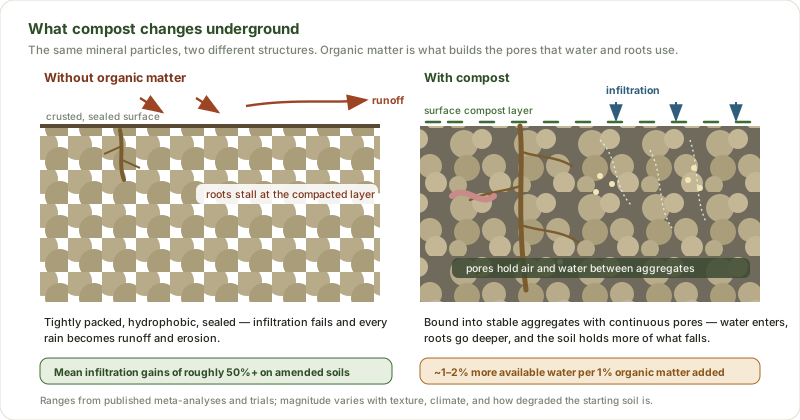
Compost's organic matter feeds the aggregation engine: microbes and their glues (polysaccharides, humic substances, fungal hyphae) bind mineral particles into stable aggregates. The visible consequences:
- Improved aggregation and infiltration — water enters rather than ponds or runs off; meta-analyses report mean infiltration gains of roughly 50%+ on amended soils.
- Available water capacity increases — roughly 1–2% more plant-available water per 1% organic matter added in many soils (magnitude varies hugely by texture).
- Reduced bulk density and crusting — easier root penetration, better seedling emergence, less energy for tillage.
- Erosion resistance — better-stable aggregates and surface cover from mulch effect reduce sheet and rill loss.
- Drought buffering — crops hold on longer between rains; the effect compounds across seasons as SOM builds.
Chemical and nutritional benefits
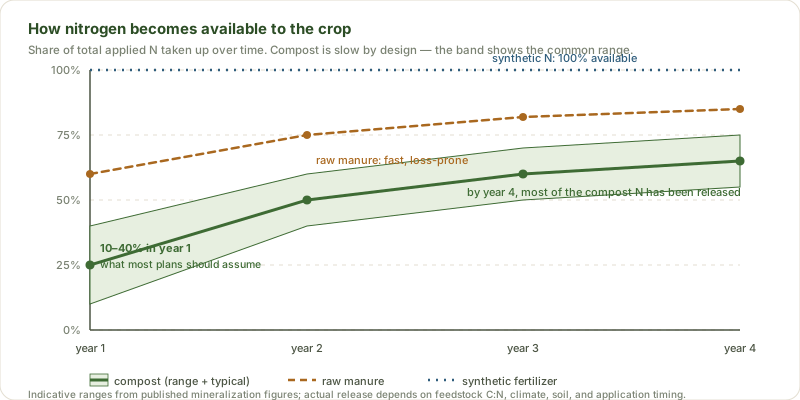
- Slow-release NPK: total nutrients in a typical 1–2% N, 0.5–1.5% P, 0.5–2% K (dry basis) product, mineralized over years rather than seasons. See the availability table in Field Application.
- CEC increase: humified matter adds cation exchange sites; sandy soils benefit most (better K, Ca, Mg retention).
- pH buffering and liming effect: compost at pH 7–8 modestly raises acidic soils; alkaline composts on high-pH soils should be watched for salinization/sodicity interaction.
- Micronutrients: broad-spectrum Zn, Cu, Mn, Fe, B, and S, much of it chelated and plant-available via fulvic complexes.
- Reduced nutrient losses: slower release better matches uptake; combined with infiltration gains, dissolved and particulate losses decline versus raw manure or split synthetic N on vulnerable soils.
Biological benefits
Compost inoculates and feeds. Consequences documented across systems:
- Higher microbial biomass and activity (dehydrogenase, β-glucosidase and other enzyme assays rise).
- More diverse communities, including beneficial Pseudomonas, Bacillus, Trichoderma, and mycorrhizal partners.
- Greater earthworm and micro-arthropod abundance — the visible engineers of structure and residue incorporation.
- Quicker residue breakdown and nutrient cycling — the system "runs faster" with fewer inputs.
Disease suppression
Compost-amended soils and media can suppress a range of soil-borne diseases — one of the most researched and commercially significant effects:
| Pathogen / disease | Documented suppression mechanism |
|---|---|
| Rhizoctonia solani (damping-off) | Competition and antibiosis by amended-media microbiomes; induced systemic resistance |
| Pythium spp. (damping-off) | General (competitative) suppression via high microbial activity |
| Phytophthora spp. (root rots) | Specific suppression where particular antagonists (e.g., Trichoderma) establish |
| Fusarium wilts | Variable; general suppression common, specific sometimes; media-based more consistent than field |
| Take-all (Gaeumannomyces) | Evidence in wheat systems; strongest where compost is part of an integrated program |
| Nematodes (root-knot, etc.) | Partial suppression via antagonists and improved plant vigor; not a stand-alone control |
Two mechanisms: general suppression — high total microbial activity outcompetes pathogens for resources and infection windows; specific suppression — particular antagonists establish and attack pathogens directly. Consistency is highest in container media; field results vary with rate, placement, and soil context. Suppression is an insurance layer within IPM, not a replacement for it.
Yield responses in research
Meta-analyses across hundreds of trials converge on these patterns:
- Average yield gains of roughly 5–15% from compost alone versus unfertilized controls; largest on sandy, acidic, degraded, or low-OM soils.
- Compost + reduced synthetic N frequently matches or exceeds full synthetic-N yields while cutting N losses — the "integrated" strategy.
- Quality effects (brix, shelf life, protein) are reported inconsistently; treat with caution.
- Benefits accumulate: multi-year trials show soil properties and yields improving over 3–5+ years of repeated amendment, then plateauing.
Measuring your soil health without a lab budget
Much of soil health is measurable in the field, cheaply, and it is the evidence that justifies (or withholds) compost spend:
| Indicator | How to check | What to record |
|---|---|---|
| Infiltration | Ring or can test (a 15 cm tin with bottom cut out, timed for 2.5 cm of water to enter) | Seconds to infiltrate, same date each year, same field zones |
| Aggregate stability | Slake test — 3–5 air-dried aggregates in water; watch for >5 min stability | Stable / partly / dispersed + counts |
| Earthworms | Dig a 30×30×30 cm cube on a damp day (or mustard-water drench) | Counts; note species (fine/hairy vs big) — changes over years are the signal |
| Veggie color & root vigor | Root digs on paired strips (with/without compost) | Depth, branching, nodulation; stump counts at harvest |
| Bulk density / penetrometer | Cheap penetrometer or soil-core oven-dry weight | Trend in g/cm³; root-restricting depth change |
| Soil tests (lab) | Annual: OM%, P, K, pH, CEC, plus optional POXC | Same lab, same depth, same season so trends are comparable |
Design the comparison right: make strips (replicated), keep fertilizer equal, measure for 3 years, and let the soil tell you where compost pays — before you spend on lab-heavy monitoring. Full-measurement programs (soil-health-scorecard panels with physical+chemical+biological tests) become worth it when you sell the story (see carbon & credits).
Realistic expectations & how to measure
- Year 1: expect infiltration and workability improvements and modest yield response; watch for N tie-up if C:N ran high.
- Years 2–4: SOM and CEC climb; water holding and drought performance visibly improve; fertilizer N can often be trimmed 10–30% on responsive soils.
- Long term: a new equilibrium SOM — compost doesn't raise OM indefinitely; a stable ceiling is reached set by climate, texture, and continued management.
- Measure it: simple replicated strip trials (with and without compost, same N plan) plus annual soil OM, P, and bulk-density checks will document your farm's response. See Field Application for rate planning.