Biochar & Compost
Pyrolyzed biomass is compost's most discussed partner: together they address each other's weaknesses. Here is the honest, current picture — what biochar is, how to charge it, what co-composting does, and what the evidence supports.
What biochar is
Pyrolysis — heating biomass (wood, crop residues, nutshells) to 350–700 °C with little oxygen — drives off volatile gases and leaves a charcoal-like solid, biochar. Unlike char burned for fuel, biochar's purpose is soil: its aromatic carbon structure resists decomposition on century timescales, making it the most durable carbon-sequestration material available to agriculture. It is not a fertilizer (it is nearly pure carbon), not a substitute for compost, and its benefits depend heavily on how it is made and charged.
Key properties (and what they mean)
| Property | Typical range | Agronomic meaning |
|---|---|---|
| Stable carbon content | 50–85% dry | Persists in soil; the sequestration story |
| pH | 7–10+ (ash-dependent) | Limes acidic soils; can be too high for acid-loving crops or fresh fractions |
| Cation exchange capacity | Low when fresh; grows as surfaces oxidize | Nutrient and water retention improves over years as surfaces age |
| Surface area | 100–400+ m²/g | Microbial habitat, water and nutrient adsorption |
| Water-holding capacity | Variable by particle size | Coarse fractions improve soil porosity; fines (<1 mm) improve retention |
| Ash & minerals | 1–15% | K, Ca, P may be present; feedstock-dependent (avoid contaminated feedstock) |
Feedstock quality is the first safety gate: biochar from contaminated wood, painted/treated lumber, or biosolids can carry heavy metals and organic pollutants. Source from certified producers (EBC in Europe, IBI elsewhere) or test first (polycyclic aromatic hydrocarbon — PAH — and metals panels).
Charging: why raw char is a poor soil addition
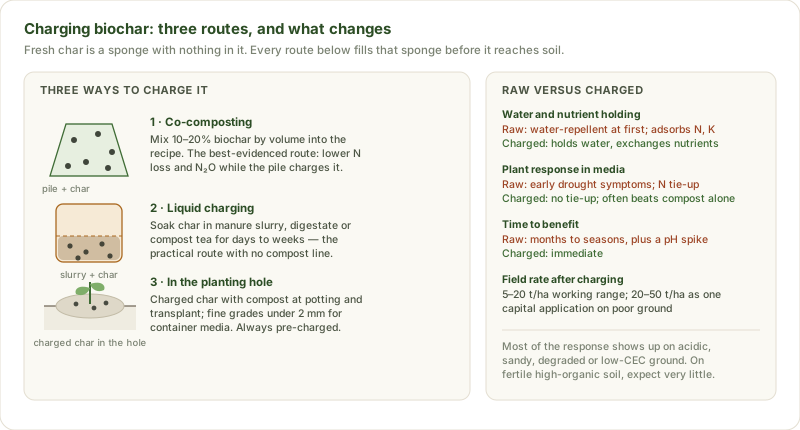
Fresh biochar is highly sorptive and nearly sterile. Applied raw, it can adsorb soil nutrients and water, temporarily immobilize N, and — being hydrophobic when fresh — shed water. This is the "priming-the-pump" problem and the reason raw-char skeptics' results are poor. The fix is charging: saturating char surfaces with nutrients and biology before soil contact.
- Co-composting (best evidence): mix biochar at 10–20% by volume into the compost recipe. The biochar is charged by the compost liquor, becomes part of the microbial community, and research shows it can reduce N losses and N₂O emissions during composting while delivering a superior product.
- Manure/liquid charging: soak char in manure slurry, digestate, or compost tea for days–weeks; a practical low-tech alternative when a compost line doesn't exist.
- Direct blending with mature compost: better than raw char but the weakest charging — surfaces still adsorb nutrients after application. Acceptable for slow-release K and P contexts.
Co-composting: the mechanics
- Rate: 10–20% biochar by volume (≈5–15% by mass) of the mix is the research sweet spot; above ~25% the char starves the microbial food supply (it adds no nutrition itself).
- Effects reported in trials: reduced NH₃ volatilization (5–30%+), reduced N₂O emissions (variable, often 20–60% in aerated systems), better retention of mineral N, improved porosity and aeration for wet feedstocks, and faster moisture management.
- Net result: "charged biochar compost" — a material that combines compost's biology and nutrients with biochar's longevity and adsorption. In media trials it often outperforms either alone on plant growth in poor soils.
- Practical caution: char dust is highly abrasive to turner parts and screens; wet the char before mixing, and screen after finish.
Application rates & placement
- Field rates: 5–20 t/ha is the common working range; research responses are mostly seen on degraded, acidic, sandy, or low-CEC soils. Single heavy applications (20–50 t/ha) are the standard strategy because biochar persists — it is a capital investment in the soil, not an annual input.
- Placement: incorporate to rooting depth rather than surface; banding near the row works for establishment. In orchards, treat once at establishment under the future canopy.
- Media: 5–15% by volume in container mixes, always pre-charged; uncharged char causes early drought symptoms.
- Potting-up and transplant: sprinkle charged char in the planting hole for perennials; fine gradings (<2 mm) work best in media.
The research evidence — what holds up
- Carbon persistence: robust — biochar is among the most stable soil carbon inputs known (half-lives commonly estimated at centuries).
- Soil chemistry: consistent — CEC and pH rise on acidic soils; nutrient retention (esp. NH₄⁺) increases.
- Yield: meta-analyses (e.g., on tropical and degraded soils) show mean yield gains of ~10–25% in the poorest soils, ~0–10% on good farmland, and some negative reports where raw char was applied carelessly or pH overshot. Do not expect a boost on fertile, high-OM soils.
- Water: held water increases on coarse soils; effects on crop water stress are best documented for sandy/very dry environments.
- Biochar-in-compost emissions: directionally supportive (N retention, N₂O reduction) but quantitatively variable — treat published ranges as indicative, not guaranteed per site.
- What's weak/uncertain: broad claims of disease suppression, mycorrhizal guarantees, and "terra preta rebirth" exceed current evidence at farm scale.
Sourcing & certification
- EBC (European Biochar Certificate): the de-facto quality standard — feedstock, PAH, heavy-metal, and stability limits.
- IBI (International Biochar Initiative): voluntary product-attribute testing.
- USDA NOP: biochar is accepted as a crop input in certified organic systems (verify current national-list status with your certifier) — but documentation of feedstock and process is expected.
- Cost reality check: at farm scale, biochar delivered commonly runs $150–800/t depending on region and grade — the investment math only closes where sequestration credits, degraded-soil response, or long-lived orchard improvements are real on your land. Local farm co-ops and ag retailers are increasingly tiling the final-mile economics (blending, delivery rates).
Cautions
- Dust: fine char is respirable and highly abrasive — wet it before handling; wear a fitted dust mask when mixing.
- pH surprises: high-ash chars can push media pH above 7.5–8, injuring acid-loving crops; test before use.
- Don't raw-apply to nitrogen-needy crops: without charging, expect a transient N immobilization/adsorption dip.
- Contaminated feedstock: paints, treated lumber, plastics, and biosolids-based char carry PAHs and metals — verify source.
- Never burn biochar's promise: its durable carbon is a soil-building asset, not a substitute for organic matter cycling; pair it with compost, manure, or cover crops.