Environmental Impact
Composting is usually the best thing to do with organic residuals — and it can still pollute when badly run. Here's what to manage, and how.
Greenhouse gases: methane and nitrous oxide
Well-aerated composting emits mostly CO₂ (biogenic, not counted as fossil carbon) plus small CH₄ and N₂O. Poorly aerated composting emits much more of both — and both are potent: CH₄ ≈ 28× CO₂ over 100 years, N₂O ≈ 265×.
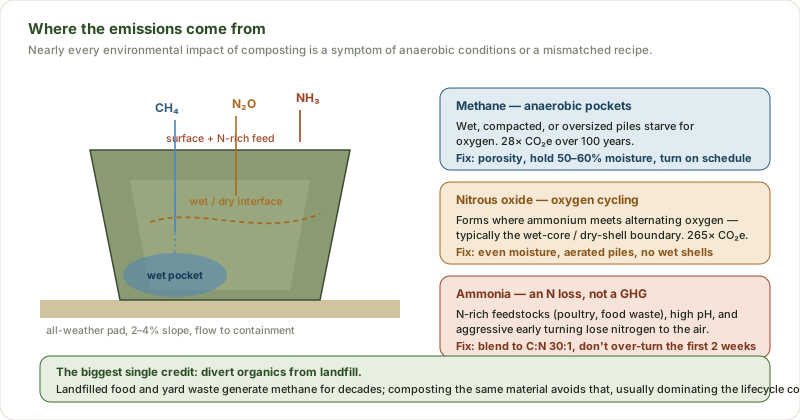
Where they come from
- CH₄: anaerobic pockets — wet, compacted, or oversized piles; especially wet manures and food waste in unturned heaps.
- N₂O: hotspots where ammonium converts through nitrification/denitrification with oxygen fluctuation — often at the wet anaerobic-core/aerobic-shell boundary; higher with high-N feedstocks.
- NH₃ (ammonia): not a GHG but an acidifying emission and an N loss — worst in N-rich feedstocks (poultry), high pH, and aggressive turning of fresh material.
Mitigation
- Maintain aerobic conditions: proper porosity, moisture 50–60%, turning/aeration discipline.
- Biochar or 5–10% fine woody additions can reduce N₂O and NH₃ losses.
- Cover piles; manage pad runoff; avoid over-size static heaps.
- For food waste, covered/aerated systems beat open windrows on CH₄/NH₃; for manure, composting beats stockpiling on CH₄.
- The big win: diverting organics from landfill avoids decades of landfill CH₄ — usually the dominant credit in lifecycle comparisons.
Water: leachate and runoff
Compost pad liquids are high in BOD, N, P, salts, and possibly pathogens. Rules of management:
| Control | Practice |
|---|---|
| Keep clean water clean | Roof gutters, diversion berms upslope; never let clean water cross the working pad |
| Shed rain | Covered bays or compost blankets/tarps on finished and curing piles in wet climates |
| Contain dirty water | Impervious or compacted pad, 2–4% slope to a settling/holding sump; vegetated infiltration or reuse for pile moisture |
| Setbacks | Follow local distances to wells, watercourses, tile inlets, property lines (commonly 30–100+ m for sensitive features) |
| Field losses | Incorporate promptly, keep 25 m+ buffers from watercourses, respect saturated/frozen-ground prohibitions (see Field Application) |
Odor, bioaerosols, and neighbors
Odor is the #1 complaint driver and the #1 regulatory trigger. The good news: odor is almost always a process-error smell — anaerobic sourness from wet/compacted piles or ammonia from N-rich mixes — and therefore fixable.
- Prevention at the recipe: correct C:N and porosity prevent most anaerobic odor; blend food scraps immediately upon receipt.
- Operational: keep receiving areas small and fast-moving; turn only when the pile is active and conditions favor dispersal (avoid still, humid evenings); run ASP exhaust through a moist biofilter.
- Biofilters: 30–60 cm moist screened compost or chips; keep evenly moist; replace media periodically; size generously (commonly cited: ~30 m² of media per 1,000 m³/h of exhaust, application-dependent).
- Bioaerosols: turning and screening release dust carrying Aspergillus fumigatus spores and endotoxin. Operators: dampen before handling, wear fitted respiratory protection, position upwind. Siting: respect distances to dwellings (often 100–250 m+ by rule or practice).
Carbon accounting and sequestration
A compost pile loses 40–70% of initial carbon as CO₂ during active composting — that's the process working. The climate math still works out positive when compost is land-applied because:
- A fraction of applied carbon becomes stable soil organic matter persisting years to decades.
- Displaced peat/soil-blends and synthetic N production carry embedded emissions avoided.
- Reduced N fertilizer rates cut N₂O from fields (synthetic N is a major N₂O driver).
- Landfill diversion avoids large CH₄ emissions (for diverted municipal streams).
Soil-carbon programs (carbon credit markets, 4-per-1000-style initiatives) increasingly recognize compost application; documentation requirements typically mirror the nutrient-management records already described.
The neighbor playbook: preventing & handling odor complaints
Odor complaints are the fastest way to get a pad shut down — and almost always preventable:
- Technically: prevent the smell at the recipe (porosity, C:N, moisture, aeration); turn only when the pile is actively aerobic and the weather disperses (avoid inversion nights, fog, and dead-calm humid evenings).
- Win before you're asked: an orientation letter to neighbors at start-up, an annual open day, a phone number pinned on a sign — goodwill is cheap and invaluable when something does go wrong.
- Log & respond: keep a complaint log (date, location, weather, activity); respond within hours, explain what you changed, and follow up. Regulators and communities forgive responsive operators far faster than silent ones.
- Buffer with vegetation & wind: tree/shrub windbreaks intercept particulates and change air-flow; position receiving toward your most forgiving direction.
- Escalate deliberately: if complaints persist, that is a process signal, not a public-relations problem — audit the recipe before spending on barriers.
Site environmental checklist
- ☐ All-weather pad, 2–4% slope, no clean-water run-on
- ☐ Leachate contained (sump/settling area) and reused or land-applied by rule
- ☐ Setbacks met to wells, watercourses, dwellings, property lines
- ☐ Feedstock receiving area small, promptly processed, vector-proof where required
- ☐ Finished product stored separately from active composting
- ☐ Temperature logs, water tests, and odor-complaint response plan on file
- ☐ Stormwater/air permits verified for your tonnage tier and jurisdiction