Process Control & Monitoring
Compost makes itself; the manager's job is to remove limits. Four variables — temperature, moisture, oxygen, and nutrition — tell you everything, and all four are measurable with simple tools.
Target ranges at a glance
Temperature: the master signal
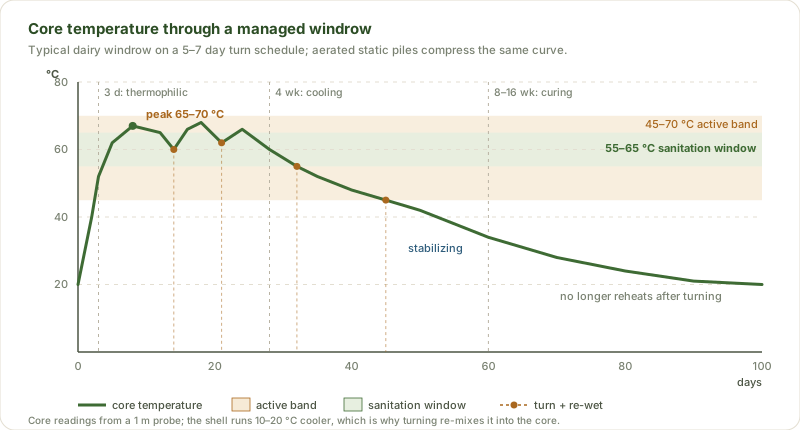
Temperature integrates everything — moisture, oxygen, nutrition, pile size — into one readable number. A 1 m probe thermometer (bimetal or thermocouple, $30–150) is the single highest-value tool in composting.
Reading the curve
- Climbing to 55–65 °C within 2–5 days: recipe and moisture are right. Hold 55 °C+ for the sanitation window (3 days ASP / 15 days + 5 turns windrow).
- Peaking above 70 °C: working too hot — enzymes denature and activity crashes. Turn or aerate to shed heat.
- Temperature falling before week 3: usually dryness, oxygen starvation, or exhausted N. Diagnose before turning.
- Uniform failure to heat (small piles): pile too small/porous to insulate; rebuild bigger or windbreak it.
- Hot center, cold shell: normal; that's why turning must re-mix shell into core, and why standards require whole-pile exposure.
Moisture
Water is the microbial medium: nutrients diffuse through it, enzymes work in it. But fill the pores with it and oxygen transport collapses. Optimal is 50–60% by weight (65–75% for strawy, fibrous mixes).
The squeeze test
Squeeze a handful hard:
- Water runs between fingers → too wet (>65%)
- Feels damp, no drops, holds shape → 50–60%, ideal
- Crumbles, no dampness → too dry (<40%)
Quantifying moisture
Weigh a fresh sample, dry at 105 °C to constant weight (oven or microwave method), and compute:
moisture % = (wet − dry) / wet × 100
Hot piles dry fast — expect to add substantial water at each turning during summer. Wet climates and covered systems may need dry browns instead. Water at turning in stages: sprinkle, mix, re-check, rather than flooding from a hose.
Aeration & oxygen
Aerobic microbes need the pore-space oxygen held above roughly 5% (air is 21%). Below that, anaerobic metabolism takes over within hours: odor compounds (volatile fatty acids, amines, reduced sulfur), slower kinetics, and methane/nitrous-oxide formation.
How piles get oxygen
- Natural convection: hot core draws air in at the base and exhausts at the top — works in windrows up to ~2.5–3 m with good porosity.
- Turning: rebuilds pore space and re-distributes material; oxygen added at turning is consumed within hours, so the structure, not the momentary O₂, is what matters.
- Forced aeration: blowers sized ~5–12 W/m³ for manure-type mixes, run on temperature feedback or timers (e.g., 30 s on / 5 min off early, lengthening as activity declines).
Symptoms of oxygen starvation
Sour, rotten-egg, or ammonia smell; black, slimy, matted texture; temperature falling despite moist material; white/gray anaerobic zones rather than actinomycete patches. Fix by turning with coarse bulking agent, reducing pile size, or installing aeration.
pH and soluble salts
pH needs little active management in most farm composts: it starts 5.5–7.5, dips slightly as organic acids form, then rises toward 7.5–8.5 as ammonia is released and acids are consumed. Interventions:
- Chronically acidic (<5.5) sour piles: usually anaerobic — fix aeration first; lime only for known-acid feedstocks (fruit culls) and sparingly (ammonia volatilization risk).
- High pH (>8.5): often over-limed feedstock or heavy ammonia phase; irrelevant in most cases but matters for ericaceous (acid-loving) crop use.
- Soluble salts (EC): can run high in manure/food-waste composts; matters for greenhouse media and salt-sensitive crops — test before container use.
Turning & aeration strategy
| Trigger | Action | Why |
|---|---|---|
| Temp peaks & falls ~5 °C | Turn (active phase) | Re-oxygenate, re-expose surfaces, re-wet |
| Temp > 70 °C | Turn to shed heat | Avoid enzyme denaturation & fire risk |
| Odor emerging | Turn + add coarse carbon | Restore pore space, rebalance C:N |
| Weeks 4–8, temps stable 45–55 | Turn every 2–3 weeks | Maintain uniformity with minimal labor |
| Temps near ambient & stable | Stop turning; begin curing | Further turning adds little; may harm fungi |
Monitoring routine and records
A one-page daily log during the active phase is sufficient and takes five minutes:
- Date, time, weather, pile ID
- Core temperatures (3+ points, two depths)
- Visual: steam, color, actinomycete patches, mites/flies
- Olfactory: none / earthy / ammonia / sour-sulfur
- Actions: water added (amount), turned (which end to which), amendments
Instruments, sensors & automation
Instrumentation exists to replace judgment calls with data where the data is cheap and mistakes are expensive. A practical ladder:
| Tier | What to buy | Cost (indicative) | What it buys you |
|---|---|---|---|
| Essential | 1 m probe thermometer (bimetal or thermocouple), moisture squeeze (free), spade, notepad | $30–150 | Temperatures, moisture, appearance — 90% of decisions |
| Practical | Digital O₂/CO₂ meter (handheld) for troubleshooting; soil-moisture probe for repeated recipe QA; compost pH test strips | $150–700 | Objective O₂/pH confirms anaerobic diagnosis instead of guessing from smell |
| Continuous | Thermocouple strings logging every few minutes; simple controllers (thermostat to blower) for ASPs | $300–2,000 | Trend lines (rate of rise/fall), automated aeration setpoints, compliance evidence |
| Automated | Wireless sensor network with cellular/data dashboard (temp, O₂, moisture), automated turning or aerating triggers, telemetry to PC/phone | $2k–10k+ | 24/7 monitoring for commercial-scale and remote sites; consistency across batches |
| Off-site/advanced | Lab analyses (TMECC panels), drone/thermal imaging at scale | $100s–1,000s/yr | Product claims, batch-to-batch QA, thermal mapping of large pads |
- The cost-benefit rule: buy the next tier only when the previous tier's data is already being acted upon and you can name a specific decision the new data would change (blower setpoint, turning trigger, moisture target).
- Calibration discipline: thermocouples drift; check probes against boiling/ice water twice a season. Loggers are only as good as their placement — probe depth and position matter more than equipment brand.
- Data as defense: continuous temperature records are the strongest compliance evidence you can hold for NOP/PFRP claims (see standards) — and the same data powers the carbon accounting story.