Compost Tea & Liquid Extracts
Water-based extracts of mature compost, brewed to carry compost's biology and chemistry onto leaves, roots, and soil. A practical primer on what teas are — and are not.
This page is formatted for printing — the button above (or Ctrl+P) produces a clean, ink-friendly PDF with content-only pages.
Definitions and distinctions
"Compost tea" is a loose term. Three very different products travel under it, and one impostor (compost leachate) is often sold as tea — it should not be:
| Product | Process | Character | Typical use |
|---|---|---|---|
| Aerated compost tea (ACT) | Compost steeped in water with continuous aeration for 12–36 h | High microbial numbers and diversity; complex flavor of biology | Foliar and soil applications; the "biological" product |
| Non-aerated compost tea / extraction (CTE) | Compost steeped in water, passively or briefly stirred, 1–7 days | Fewer bacteria, more soluble chemistry; variable biology | Soil drenches, leach-mineral extraction, cost-sensitive operations |
| Compost water extract (humic-rich) | Long, controlled steep (days–weeks) aimed at humic/fulvic fractions | Chemistry-focused, low live biology | Seed treatment, potting-mix amendments, biostimulant claims |
| Compost leachate ⚠ | Drainage water from an active composting pile or pad | Dark, high-BOD, high salts, often anaerobic, can carry pathogens | None for food crops. Manage as wastewater (see Environmental Impact) |
| Plant teas (comfrey, nettle, etc.) | Fermentation of green plant material | Nutrient-rich, microbe-poor, strong odor | Foliar feeding; a fertility product, not a biological one |
What's actually in the tea
- Microbes: a well-brewed aerated tea typically carries 10⁵–10⁸ bacteria per mL plus fungi, protozoa, and small numbers of nematodes, drawn from the compost itself. Microbial counts and diversity reflect the compost far more than the brewer.
- Soluble chemistry: small amounts of NH₄⁺, NO₃⁻, K, and micronutrients, plus organic acids, amino acids, and plant hormones left over from decomposition. Nutrient concentrations are generally an order of magnitude below fertilizer-strength — tea is not a nutrient delivery system.
- Humic/fulvic fractions: soluble humic substances, relevant for their chelation and root-stimulation effects, are more concentrated in long, un-aerated extractions than in short ACT brews.
What teas are for — and not for
Reasonable uses
- Inoculating leaves with a living microbial community (foliar)
- Soil and compost-pile drenches to distribute biology at planting
- Seed and transplant drenches to help establishment
- Delivering humic chemistry and small nutrient doses (extraction)
- Including compost-derived biology into no-till and direct-seeded systems
Unreasonable expectations
- As fertilizer: nutrient load is small; budget fertility separately
- As pesticide: teas are not registered pesticides; health claims based on disease "control" are legally risky in several jurisdictions (e.g., pesticide-registration regimes) and scientifically shaky
- As rescue for bad soil — it is a microbial seed packet, not compost's replacement
- As a sanitation tool — extraction never "cleans" bad compost; see food safety below
Brewing: design & parameters
| Parameter | ACT (aerated) typical range | Why it matters |
|---|---|---|
| Compost:water ratio | 1:5 to 1:10 by volume | Extraction concentration; dilute for composts with high salt |
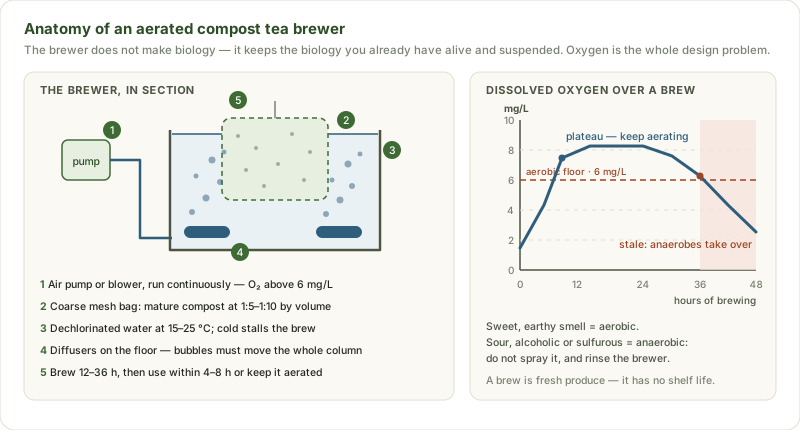
| Aeration | Continuous, vigorous (bubbler or venturi); keep O₂ > 6 mg/L | Aerobic microbes dominate; anaerobes and pathogen regrowth appear when oxygen lapses |
| Brew time | 12–36 h; rarely > 48 h | Growth plateaus; longer brews go anaerobic and smell |
| Temperature | 15–25 °C | Mesophilic window; too cold stalls, too hot shifts community |
| Feedstock activation (molasses etc.) | Small amounts — ~0.1–1% by volume (e.g., 5–10 mL/L unsulfured molasses) | Supports bacterial bloom; food-based additives also feed any pathogens present — use only with tested compost |
| Filtering | Coarse (250–1000 µm) or none for soil drenching; fine for sprayers | Fine filters remove fungal hyphae and the largest protozoa |
| Storage | Use within 4–8 h; or keep aerated up to 24 h | Decomposition resumes immediately; stale tea becomes anaerobic |
Brewer scale: a 20–100 L bucket/barrel with an aquarium pump or venturi is enough for a small farm; 200–1,000 L tanks with blowers and bag filters serve larger operations; commercial brewers (sometimes 5,000 L+) exist but the biology does not scale linearly — batch size mostly just repeats the same brew.
Choosing the compost
- Mature and stable: raw or immature compost extracts poorly and can bring phytotoxic salts and ammonia into the tea (see maturity). Use Solvita-tested or equivalent stable product.
- Pathogen-screened: for any edible crop, brew only from compost with documented pathogen testing (fecal coliform < 1,000 MPN/g and/or Salmonella not detected). See pathogen standards.
- Feedstock history: no biosolids or sewage-derived compost for food crops; be alert to persistent herbicide and PFAS liabilities in untested feedstocks.
- Diverse source: a mixed-manure-and-yard compost carries a more diverse community than a single-feedstock product.
Application methods & rates
| Route | Typical use rate | Timing notes |
|---|---|---|
| Foliar | Dilute 1:4 to 1:20; apply 100–500 L/ha | Early morning or late evening; not in hot sun; re-apply after rain |
| Soil drench / at planting | Undiluted to 1:5; 10,000–30,000 L/ha (or per transplant ~0.5 L) | Band near seed row or drip line; incorporate promptly |
| Seed soak / dressing | 1:5–1:10, 5–15 min soak | Rinse after; use only tested compost for food crops |
| Compost pile activation | 1:5, sprinkle into layers at build | Complements but never replaces recipe management |
- Tea has essentially no residual value — treat it as fresh produce: brew, apply, repeat on a schedule rather than storing.
- Sprayer hygiene: rinse lines and nozzles immediately; dried tea is a biofilm hazard in irrigation systems.
- Keep the same brew moving in one session where possible; split batches for multiple sites rather than dragging one batch all day.
Three recipes
1) 20 L bucket brew (small farm / trial)
- 2 kg mature, pathogen-tested compost in a mesh bag
- 18 L dechlorinated water (let tap water sit 24 h or use rain water)
- 2–5 mL unsulfured molasses (only if starting from tested compost; omit for food crops)
- Aerate continuously with an aquarium air pump (two stones) for 24 h at 18–24 °C
- Use within 4–8 h; dilute 1:5 for foliar work
2) 200 L farm brew
- 20–30 kg compost in a 500 µm filter sock; suspend in a 200 L drum
- Fill with dechlorinated water; aerate with a small blower and two diffuser stones
- Brew 24–36 h; keep temperature below ~28 °C (shade the drum in summer)
- Strain coarse; apply to soil at 1:3–1:10 with a sprayer or injector
3) Passive humic-rich extraction (no pump)
- 10 kg mature compost in a barrel; fill with water; cover loosely
- Steep 3–7 days in shade, stirring twice daily
- Strain; expect a chemistry-rich, biology-poor liquid in excellent condition
- Use as seed soak or soil drench at 1:10; do not spray on food crops without testing (long anaerobic passage)
Safety & food-safety limits
- Labeling/claims: in many regions (e.g., Oregon, Canada, EU member states), advertised disease-suppression claims can classify a tea as a pesticide requiring registration. Market it as a soil- and plant-conditioning inoculant, not a control product.
- Organic production: teas brewed from NOP-compliant compost are generally allowed under NOP, but verify with your certifier; leachate and non-composted-manure teas are not compliant feedstocks.
- Operator exposure: stirring, filling, and spraying release bioaerosols (see bioaerosols); wear gloves and a fitted respirator when handling concentrated brews, and avoid overhead spraying on windy days.
- Water quality: start from potable or clean rainwater; never from manure-contaminated sources.
What the research shows
- Biology: multiple studies confirm ACT carries viable bacteria and fungi in the 10⁵–10⁸/mL range, with diversity tracking the source compost. Community composition is highly variable between batches.
- Disease suppression: the seminal review (Scheuerell & Mahaffee, 2002) found teas reduce some foliar diseases in some trials (e.g., Botrytis, powdery mildews) but effects are inconsistent, method-dependent, and far weaker than managed compost amendments in soil. Few field-scale confirmations exist.
- Plant response: positive responses are frequently reported for seedling establishment and early growth; whether this is hormonal (humic/auxin-like), nutritional, or microbial is unresolved — treat claims of yield gains skeptically unless strip-tested.
- Pathogen risk: the OSU regrowth finding is robust; food safety must be engineered, not hoped for.
- Bottom line: teas are low-cost, low-risk biological conditioning with plausible but modest benefits — an addition to, never a replacement for, good compost and agronomy.
Tea troubleshooting
| Symptom | Cause | Fix |
|---|---|---|
| Strong sour/rotten smell by 24 h | Oxygen lapsed or brew too long | Increase aeration, shorten brew to 12–18 h, use fresh compost |
| Thick foam overflowing | Over-fed with molasses or very N-rich compost | Cut additive to ~0.5% or omit; dilute next batch 1:2 |
| Clear, no cloudiness | Old/dead compost or over-filtered | Use freshly finished, mature compost; filter coarsely or not at all for soil |
| Microbial counts low (if testing) | Chlorinated water, cold temperatures, stale compost | Dechlorinate; brew at 18–25 °C; brew from a blended, rich compost |
| Phytotoxicity on sprayed leaves | Salts or ammonia from immature compost; too-concentrated | Dilute 1:10+; switch to tested mature compost |