Climate & Seasonal Operations
The process biology is identical everywhere — but climate decides which lever binds first. In cold climates you defend heat; in arid ones you defend water; in monsoon climates you defend the pile from the sky; in the tropics you manage speed itself. This chapter is the same physics, sorted by weather.
Climate sets the binding constraint
Every pile balances the same ledger — heat generation, heat loss, water in, water out. Climate doesn't change the ledger; it changes which line goes negative first. Know your binding constraint and the design choices organize themselves:
| Climate band | Primary stressor | Second stressor | Design response |
|---|---|---|---|
| Cold / continental | Convective + latent heat loss; water locked as snow/ice | Short operating season | Mass, covers, windbreaks, fall pre-build (see winter) |
| Hot-arid | Desiccation of the working shell | Dust/bioaerosols; fire risk in big dry piles | Water infrastructure, shade, mulch caps, re-wet discipline (see arid) |
| Monsoon / wet-dry | Rain on open piles — saturation, leachate, N loss | Browns go wet when needed most | Covered systems, dry-season carbon banking (see monsoon) |
| Humid tropics | Everything runs fast — organics burn out, N volatilizes | Continuous pest/disease pressure | Higher browns fraction, smaller faster cycles, shade (see tropics) |
Cold & snow
Freezing is a constraint, not a stop sign. The pile's defense is geometry: heat generation scales with volume, heat loss with exposed surface — so big piles survive and small ones die.
- Size for survival: ≥2–2.5 m high windrows with a large footprint; batch size big enough that a hot core exists even after edge chill. Below ~1 m³ nothing survives deep cold without help.
- Fall pre-build is the master move: build the winter batch in late autumn while moisture and temperature cooperate, let it reach full thermophilic heat, then let mass and cover carry it through (see cold-weather operations).
- Fresh-N fuel: winter piles need fresh, moist, N-rich material — old stockpiled manure has already spent its heat.
- Cover strategy: tarps shed snow and trap the insulating air layer; a 15–20 cm straw or coarse-chip blanket over the tarp layer is windrow insulation. Remember snow = water: 1,000+ L per metre of windrow arrives at melt (see water balance) — keep snow off the pile, and keep spring melt away from it.
- Turning discipline: every turn vents stored heat. In deep cold, turn only to fix a diagnosed stall — and never fold frozen crust into the hot core (thermal shock stalls the batch).
- Expect 60–70% of warm-season rates: longer active phase, slower edges; plan curing capacity accordingly.
- ASP notes: positive-air only in freezing climates; exhaust steam is normal latent-heat loss, not a fault; timer control beats temperature feedback for edge-chill avoidance; insulate manifold and laterals, and give condensate a drain that can't freeze shut (see ASP design).
Hot & dry
In dry climates the enemy is the drying shell: evaporation strips the outer 15–30 cm, which turns to a cracked, hydrophobic crust — insulating the (still wet) core from your water and steering the pile toward the fire-risk end of the spectrum (see overheating & fire risk).
- Water is the binding infrastructure: site the operation within reach of a real water line — the 2" pump-and-sprinkler setup is the most-underrated cost in dry regions (see equipment choices). Re-wet at every turning, not on symptom.
- Build bigger, turn less: large piles have favorable surface-to-volume; each unnecessary turn is an evaporation event. Target the core, not the shell.
- Start wetter: begin at the upper end of the moisture band (~60%) so the drying shell still leaves a workable core; the moisture calculator sizes the water addition.
- Shade and wind: shade cloth or a north-side (south-side in the southern hemisphere) placement cuts radiant load; windbreaks cut the evaporative stripping that wind adds. Dust from dry screening and turning is a bioaerosol exposure — wet down before working (see bioaerosols).
- Mulch cap ("biocover"): a 5–10 cm skin of finished compost or coarse straw on the working pile cuts shell evaporation sharply and doubles as odor/ fly control — the same envelope logic as mortality piles, applied lightly.
- Recipe shift: favor water-holding carbons (straw, shredded leaves) over pure chip recipes; fine-to-medium texture holds the water film microbes need.
- Fire discipline: dry + big + static is the self-heating recipe — probe-monitor any pile over 3 m, and never let a dried static pile sit unmonitored through the hot season.
Monsoon & heavy rain
A single monsoon month can deliver 1,000–2,000+ L/m² — an open windrow is a sponge in a flood. Saturation drives the cascade: oxygen collapse → anaerobic odor and methane → leachate generation → nitrogen washing out (see GHG management and containment).
- Covered systems win: a covered receiving bay plus covered ASP or covered bays is the monsoon system of choice; roofs are the single best water investment on a wet-climate farm (the same conclusion as the pad water-balance example).
- Open-windrow fallback: crown every pile and keep covers (tarp or 10–15 cm compost skin) intact; rebuild pile slope after every big event so water sheds, not soaks.
- Never turn a saturated pile: you'll smear structure into seal, vent the remaining air, and lose heat — wait for the dry window, then turn with dry carbon and rebuild ≤2 m (see too-wet fixes).
- Dry-season carbon banking: the defining monsoon discipline. Browns are abundant and dry when it isn't raining and absent-and-wet when it is — stockpile 6–12 months of dry carbon under roof in the dry season. The carbon bank is what lets you re-carbon a soaked pile the day the rain stops.
- Leachate readiness: sump sized and pumped before the season; reuse on active piles is the first outlet (see treatment & reuse).
- Build to the season: start big batches at the tail of the dry season so the active phase runs into the rains with the pile already hot, structured, and covered — a saturated pile that is already thermophilic survives its monsoon; a fresh one doesn't.
Humid tropics: managing speed
Year-round warmth removes the mesophilic lag — piles ignite in hours and can finish active decomposition in 4–6 weeks. Speed is the asset and the problem: hot, fast, wet organics burn out nitrogen and organic matter quickly, in the pile and later in the soil.
- Recipe for speed control: start at the high-carbon end (35–40:1) and lean on browns; the constraint is keeping structure and N in the pile, not getting it hot (see browns & greens).
- Smaller, more frequent cycles: short cycles match fast feedstock decay and spread labor; the curing phase still earns its weeks (see curing).
- Shade cloth over windrows moderates both the intense-sun drying and the intense-rain hammering — the tropical version of climate control at almost no cost.
- Continuous pest pressure: flies and vectors don't get a winter break — cap fresh material instantly and keep receiving areas small (see vector management).
- Product mineralizes fast: warm soils burn organic matter quickly, so the agronomic pattern shifts to more frequent, lower doses timed to crop cycles rather than single large applications (see rate logic).
- Monsoon sub-season: within the tropics, the wet months adopt the full monsoon playbook above — covered bays, carbon bank, build-before-the-rains.
The seasonal calendar
A temperate-farm template — shift rows to your climate (in wet-dry regions the "seasons" are wet and dry, and the rows re-key to the monsoon section):
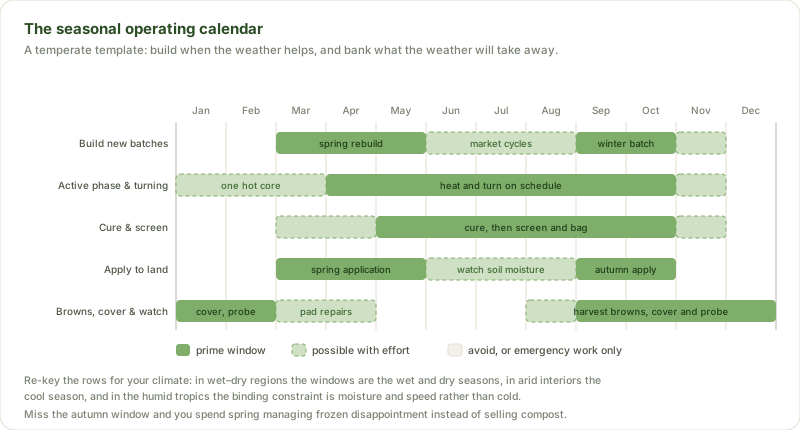
| Season | Build | Manage | Watch |
|---|---|---|---|
| Spring | First batches of the season; re-wet and restart overwintered stock | Moisture checks and early turning rhythm; screen last year's cured product (see screening) | Saturated ground and pad; melt-water routing; pad repairs before heavy traffic |
| Summer | Rapid cycles on fresh manure; build for the market season | Water at every turn (arid); heat-watch above 70 °C; covers on stored product | Fire risk in big dry piles; dried shells; neighbor odor in still heat (see odor) |
| Autumn | The build window: pre-build winter batches at full size; harvest browns (leaves, stover, straw) | Bank dry carbon under roof; final screening and bagging push before weather closes | Leaf/ residue moisture swings; early frost stalls on small piles |
| Winter | Minimal — only large, fresh-N builds; keep one hot core alive | Cover integrity; probe the core weekly; turn only on diagnosis | Frozen crusts; snow load on tarps; frozen sumps and water lines |
Climate troubleshooting
| Symptom | Likely cause | Fix |
|---|---|---|
| Pile frozen solid through | Too small, built too late, no cover | Merge into a ≥2 m mass with fresh N-rich material and a tarp; expect a 1–2 week lag before recovery |
| White, powdery, cracked shell (heat) | Desiccation of the working zone | Re-wet at turning (20–30% of mass as water is not unusual); add a mulch cap; shade the line |
| Sour, slumped pile after a wet week | Saturation → anaerobia | Don't turn it wet; open drainage, wait for the dry window, then rebuild ≤2 m with dry carbon (see too-wet) |
| Steam plume all winter | Normal latent heat loss | Nothing — it's the pile breathing; check cover integrity instead |
| Spring collapse: cold, sunken piles | Winter saturation + freeze–thaw | Rebuild with fresh browns and N; treat as a restart, not a repair |
| Sump overtops in storms | Under-sized basin or blocked outlet | Emergency pumpdown plan; enlarge or divert (see water troubleshooting) |
| Dust clouds at turning/screening | Arid over-dry material | Wet down before working; PPE; screen at ≤40% moisture (see bioaerosols) |