Water & Leachate Management
Composting is a water business wearing a carbon costume. Too much water starves the pile of oxygen; too little stops the microbes; and the water that exits — as vapor, runoff, or leachate — carries your reputation with it. This chapter is the full water story.
The pile water balance
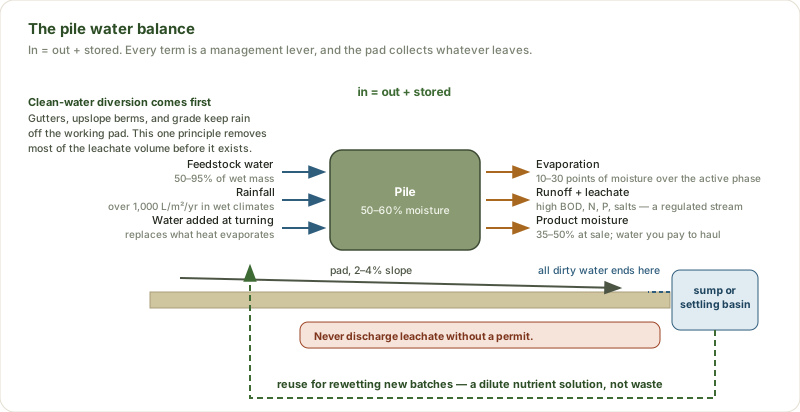
A compost pile is a three-term water ledger: in (feedstock water, rainfall, added water) = out (evaporation, runoff, leachate, product moisture) + stored. Walk the terms:
| Term | Typical magnitude | Management lever |
|---|---|---|
| Feedstock water | 50–95% of wet feedstock mass | Recipe: dry browns absorb it; bulking agents create drainage paths |
| Rainfall | Variable; can exceed 1,000 L/m²/yr in wet climates | Roofs, covers, clean-water diversion — the biggest single lever in rainy regions |
| Evaporation from active piles | 10–30 percentage points of moisture over the active phase | Turning & rewetting discipline; porosity keeps air moving |
| Leachate + runoff | Anything that leaves as liquid is a pollution vector | Pad design below; never "accept it, container it" without a plan |
| Product moisture | 35–50% typical finished | Marketing + transport economics; dry before sale |
Leachate chemistry: why it's not just "dirty water"
Compost leachate is a concentrated organic extract. The numbers matter for sizing treatment and for regulators:
| Parameter | Typical fresh leachate range | Why it matters |
|---|---|---|
| Biochemical oxygen demand (BOD₅) | 2,000–20,000+ mg/L | Oxygen demand in receiving water; fish-kill driver |
| Ammonia-N | 100–2,000+ mg/L | Aquatic toxicity (un-ionized NH₃), algal growth |
| Total P | 10–500 mg/L | Eutrophication; often the binding permit limit |
| Soluble salts (EC) | 10–40+ dS/m | Blows up soil salinity if land-applied ungauged |
| Suspended solids | 1,000–10,000 mg/L | Turbidity, sediment, P sorbed to particles |
| Heavy metals | Usually low in clean feedstocks | Concentrate in drying residue; test if biosolids inputs |
Pad design & containment
The pad is the water system. A capable on-farm pad (moderate scale) has:
- All-weather base: compacted gravel (10–15 cm) over geotextile, or concrete for commercial yards; 2–4% slope to a collection point. The base's job is structural (equipment traffic), not watertightness by itself.
- Clean-water diversion FIRST: upslope berms, roof gutters, and grade keep rain off the working area — clean water must never cross the pad. This single principle prevents 80% of leachate volume.
- Containment geometry: pad is slightly crowned or sloped so all dirty water flows to a low point; a perimeter collection channel (30×30 cm min) leads to a settling basin or sump.
- The sump: a simple lined catch basin (double-liner + leak detection for commercial classes) sized for your 10-yr storm + 7 days of worst-case rain, with a pump or gravity outlet — never an overflow pipe to the environment.
- Curing & storage areas included: finished product sheds are the same hardstand + collection story; never let curing piles sit in a puddle.
- Setbacks: to wells, watercourses, and tile inlets — commonly 30–100 m+, and more for commercial classes; verify locally (see regulatory map).
Treatment & reuse options
| Option | How it works | Best for | Watch out |
|---|---|---|---|
| Reuse for pile rewetting | Pump sump back onto active piles (it's dilute organic fertilizer) | Small-to-medium farms; closes the loop | Don't reintroduce to near-finished product; don't oversaturate; salts concentrate with reuse |
| Vegetated treatment / constructed wetland | Shallow lined cells with cattails/reed canary; BOD/N removal by microbes + plants | Steady small flows, space available | Seasonal cold kills winter performance; needs outlet testing if discharging |
| Land application (agronomic) | Spread on bermed ground exceeding crop N/P needs, incorporated | Farms with land; the ag outlet | Cap by P, follow setbacks; many jurisdictions require a permit + testing even for this |
| Direct discharge | — | Never without permit | Prosecution and fish kills |
| Commercial treatment | Contract haul to a WWTP/lagoon | When all else fails at commercial scale | Cost per m³ is real; budget it |
Reuse is the farmer's first answer — leachate is roughly a 0.1–0.5% N dilute liquid fertilizer at pile moisture, ideal for rewetting new batches and for fertigating fallow-area cover crops (sparingly, at agronomic rates). The moment you stop thinking of it as wastewater and start thinking of it as a dilute nutrient solution, the design relaxes.
Field losses: the other water story
Half of leachate risk is in the field, not the pad. Application-time losses — runoff, tile bypass, saturated-ground movement — dwarf pad leakage in most farm systems:
- Incorporate within 24–48 h (or inject); surface-lying compost on sloping ground is the runoff pathway.
- Respect the no-spread window: frozen, snow-covered, saturated, or standing-water fields are prohibitions, not suggestions (see timing).
- Buffers: 25 m+ from streams, 10 m from tile inlets (US NRCS guidance; many states require more), grassed waterway where slope concentrates flow.
- Cap the rate by P: over-application is a chronic, invisible non-point source; the rate calculator is built to catch it.
- Tile-drained fields are not exempt: preferential flow can move dissolved N and salts in hours after a storm; time applications ahead of big rain events.
Regulatory baseline
- Industrial stormwater (US): larger facilities (tonnage thresholds) need a permit with a written BMP plan and sampling; the plan usually includes the pad, containment, and spill-response clauses.
- NPDES/state discharge: any discharge pipe to a watercourse triggers a permit; the default answer is no discharge — containment and reuse.
- Agricultural exemption nuance: farm-recycling operations often sit under the solid-waste exemption but not under a water exemption — the water rules bite first (see regulatory map).
- Wetland/riparian rules: setbacks from wetlands and karst (sinkholes) are strict in many regions; check locally before siting anything.
- Document everything: a one-page water plan (pad layout, basins, reuse schedule, spills log) is the cheapest defense in any audit.
Testing your water: a practical panel
For most on-farm operations, an annual panel on sump water is enough (more if you discharge or land-apply):
- pH, EC, BOD₅, ammonia-N, nitrate-N, total P, TSS — the core. ~$150–300 per sample; many ag labs run a standard "lagoon/manure water" panel.
- Metals: only if feedstocks include biosolids or industrial byproducts.
- Pathogens (fecal coliform): only if you land-apply to produce fields or discharge — and if you do either, revisit the plan.
- Sample correctly: mid-depth, after mixing, in a clean 1 L bottle, on ice, ship same day.
Same water, same sampling discipline as compost: the number is only as good as the sample and the chain of custody.
Worked example: is your pad big enough?
Scale: 200 t/yr throughput, 60% moisture average, in a 900 mm/yr rainfall climate with a dry summer.
- Feedstock water: 200 t × 0.60 = 120 t water in feedstocks
- Reasonable active-phase evaporation: ~30% of pile water = ~36 t reabsorbed by turning/rewetting cycle
- Remaining moisture leaving with product: ~25 t at 40% moisture
- Balance: 120 − 36 − 25 ≈ ~60 t/yr of 'surplus' water to manage as wet-season leachate + rewetting reuse need
- Rainfall on an open pad: 500 m² pad × 0.9 m = 450 t/yr — which is why roofed/curing storage and clean-water diversion cut the actual leachate volume by an order of magnitude, and why a covered receiving area is the single best water investment on a wet-climate farm.
Right-size a sump for the 10-yr storm plus a dry-week buffer, then test and reuse. The numbers above are planning guides — not design calculations; have a civil engineer check sizing at commercial scale.
Water troubleshooting
| Symptom | Cause | Fix |
|---|---|---|
| Sump overflowing | Under-sized basin, blocked outlet, or storm coming | Overflow response plan: temporary storage, pumpdown, reduce pad area, divert clean water harder |
| Ponding on pad | Flat or negative slope, blocked channels, saturated base | Re-slope to collection, clear channels, add stone/reinforce base |
| Weeds/odor at low corner | Stagnant leachate, no circulation | Pump it out to reuse or treatment; don't let it sit |
| Neighbor complaint re: runoff | On-pad or field loss | Stop the source first (contain), then test, then explain with your water plan |
| Tile-drain discoloration downstream | Field oversaturation or preferential flow | Buffers, correct rates, avoid fall-winter applications on drained ground |