Troubleshooting Guide
Almost every compost problem is one of five causes: too wet, too dry, wrong C:N, not enough air, or not enough mass. Prefer a guided path? Use the interactive diagnoser — it walks this same decision tree question by question.
Quick reference: symptom → cause → first move
Print this one. It covers the same ground as the sections below, in the order you will meet the problems.
| Symptom | Most likely cause | First move |
|---|---|---|
| Cold pile, material crumbles | Too dry — the single most common cause | Rebuild in layers, wetting between each; target 50–60%. A dry pile resists water, so go slowly |
| Cold pile, wringing wet | Saturated and anaerobic; oxygen cannot reach the microbes | Open drainage first, then turn in dry coarse carbon. Do not turn a saturated pile |
| Cold pile, moisture and recipe look right | Too little mass — below about 1 m³, heat loss beats heat generation | Combine piles to ≥1 m high × 1.5 m wide, or lengthen rather than heighten |
| Heated well, then stalled after 3–4 weeks | Available nitrogen spent, or the pile dried out from its own heat | Turn while adding a green source and water; expect a second climb |
| Sharp ammonia smell | Excess nitrogen volatilizing at high pH | Blend in browns to push C:N to 30–35:1; stop over-turning fresh N-rich material |
| Sour, rotten-egg or vomit smell | Anaerobic pockets from wet, compacted material | Turn with dry coarse carbon immediately; rebuild no taller than 2 m and cover against rain |
| Core above 70–75 °C | Very active, dense mix; dry pockets forming | Turn to shed heat or reduce pile size; monitor any pile over 3 m for internal dry pockets |
| Flies breeding on the surface | Exposed fresh food scraps or manure | Cap every fresh addition with 10–15 cm of finished compost or browns |
| Pile frozen solid through | Too small, built too late, or left uncovered | Merge into a ≥2 m mass with fresh N-rich material and a tarp; allow 1–2 weeks to recover |
| Still recognizable after months | Carbon- or mass-limited: chips and stalks decompose slowly by design | Screen out the wood and return it to the next batch; rebuild as a managed pile if you need product this season |
Recheck the temperature 48 h after any single change — make one correction at a time so you learn which one worked.
Pile won't heat (or barely reaches 40 °C)
Too dry (most common)
Squeeze test: material crumbles, no dampness. Fix: rebuild the pile in layers with water sprinkled between them, or turn while wetting thoroughly — a dry pile resists wetting, so go slow. Target 50–60%.
Not enough nitrogen (C:N too high)
Recipe is all browns (straw, chips, leaves with little manure). Fix: add greens — manure, food scraps, alfalfa, blood meal — and rebuild. Aim 25–40:1; verify with the C:N calculator.
Pile too small
Below roughly 1 m³ (windrows below ~1 m high), heat loss beats heat generation. Fix: combine piles; minimum practical size is ~1 m high × 1.5 m wide for reliable heating without forced aeration.
Too much air flowing through
Overly coarse mix (all chips) or exposed, windy site: heat convects away. Fix: add finer material, make the pile bigger/longer rather than taller, or use a windbreak/tarp.
Cold weather + small mass
Winter piles need extra mass (bigger footprint, 1.5–2 m height), fresh manure "starter," or covering. Composting continues year-round in large piles; small ones simply freeze.
Material already decomposed
Old stockpiled manure or leaf mold may already be stable — nothing left to decompose. Test with a Solvita/Dewar check before "fixing" a non-problem.
Heats fine, then stalls early
Ran out of nitrogen
High-C recipes consume available N in the first weeks. Fix: turn while adding a green source dissolved or sprinkled through the pile.
Dried out from the heat
Active piles dry fast; a stalled pile that's dry inside needs water at turning (50–60% target). This is the most common stall after week 3.
Oxygen exhausted, structure collapsed
Wet, fine materials slump and seal. Fix: turn with coarse bulking agent (chips), rebuild smaller if very wet.
Odor problems
Rotten-egg / sour / vomit smell = anaerobic
Oxygen starvation from wet/compacted conditions. Fix immediately: turn with dry, coarse carbon; rebuild no taller than 2 m; consider covering against rain; if recurring, move to ASP or reduce pile size. See odor management.
Ammonia smell = too much N / pH high
Excess nitrogen volatilizing (common with poultry litter and fresh manure). Fix: blend in high-C browns to push C:N to 30–35:1; avoid over-turning fresh N-rich material; lower moisture slightly.
Odor only at turning
Normal if brief and earthy; a strong sour blast means anaerobic pockets — see above. Turn more frequently (smaller correction, more often) rather than rarely (large correction).
Too wet (rain, slurry, wet feedstocks)
Active fixes
Turn with dry browns (straw, sawdust, dry leaves, wood chips); cover the pile; rebuild with a 10–15 cm porous base to drain; in ASPs, increase airflow temporarily to strip water.
Prevention
Cover or roof receiving/storage areas in wet climates; schedule windrow builds for dry windows; keep a dry browns stockpile under cover as your "absorbency reserve."
Too dry
Active fixes
Rebuild with staged watering; drip/sprinkler lines or SPD (soaker hose) laid in the pile for slow deep wetting; add naturally wet feedstocks (slurry, food scraps) to the next recipe.
Prevention
Check moisture at every turning; in hot/dry climates, consider more frequent lighter turnings with water rather than rare heavy ones; windbreaks reduce convective drying.
Flies, rodents, and other vectors
Flies breeding in the pile
Exposed fresh food scraps or manure on pile surfaces. Fix: always cap fresh additions with a 10–15 cm layer of finished compost, browns, or already-hot material; turn promptly so surfaces heat; keep receiving areas tiny and fast-moving.
Rodents/attracted wildlife
Usually meat/dairy or unmanaged food scraps. Fix: exclude attractants (or pre-compost via bokashi), enclose the receiving area, and maintain active hot piles (rodents avoid hot cores).
Overheating and fire risk
Temperatures above 70–75 °C
Turn to shed heat, or reduce pile size; if recurring, the mix is very active and dense — aerate deliberately. Sustained >77 °C also violates NOP's upper bound for raw-manure compost (see standards).
Smoke or internal fire
Rare; requires large dry piles with internal dry, compacted pockets. Pull the pile apart with equipment (never by hand), spread and wet it thoroughly. Prevention: don't stack huge static piles of dry material; monitor temperature in piles over 3 m.
Cold-weather operations
Freezing is a constraint, not a stop sign — with the right expectations:
- Large is warm: a 2 m+ high, long windrow of fresh, moist, N-rich material self-insulates; keep a rotating supply of fresh hot batches and never merge frozen crusts into a hot core (thermal shock).
- Pre-build in fall: the single most practical move — build the winter batch in late autumn while temperatures and moisture cooperate, then let the pile heat and hold through the cold.
- Cover wins: tarps or a roof keep snow out (snow in the pile = 1,000 L+ of water per metre of windrow melting in spring) and reduce convective heat loss.
- Turning less, later: turn less frequently in deep cold; each turn exposes the core to −20 °C air. Turn at midday only.
- Frozen margins are normal: the shell freezes — that's insulation, not failure; reopen with spring turnings and expect the active phase to resume on the thaw.
- Water management: frozen pads crack; apply gravel/tire-pad or snow-plow first pass; fix drainage in summer so spring melt doesn't puddle round the pile.
- The full seasonal picture: cold is one of four climate regimes with its own playbook — see Climate & Seasonal Operations for winter, arid, monsoon, and tropical strategy plus the seasonal calendar.
Never seems finished / still recognizable after months
Woody material intact
Chips and stalks decompose slowly by design (that's why they're screened and reused). If too much remains: screen it out and return to the next batch; shred finer next time; ensure N wasn't limiting.
Pile stays cool, material barely changes
The passive-pile scenario: no mass, no moisture management, low N. Fine for slow leaf-mold; not fine if you need product this season — rebuild as a managed pile.
A decision tree for the stuck pile
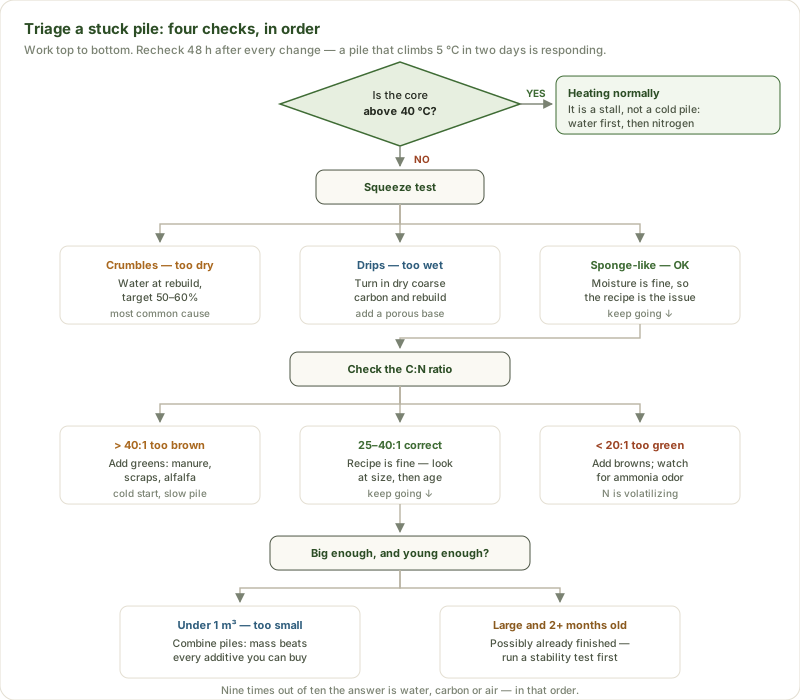
Recheck 48 h after every intervention with a fresh temperature read: a pile that climbs ≥5 °C in 2 days is responding; one that doesn't moves the diagnosis to the next node.
The 90-second diagnostic
1) Squeeze test (moisture). 2) Smell (earth = good, ammonia = too much N, sour = anaerobic). 3) Temperature profile (hot core? uniform?). 4) Recipe review (C:N, particle size). Nine times out of ten, the fix is water, carbon, or air.