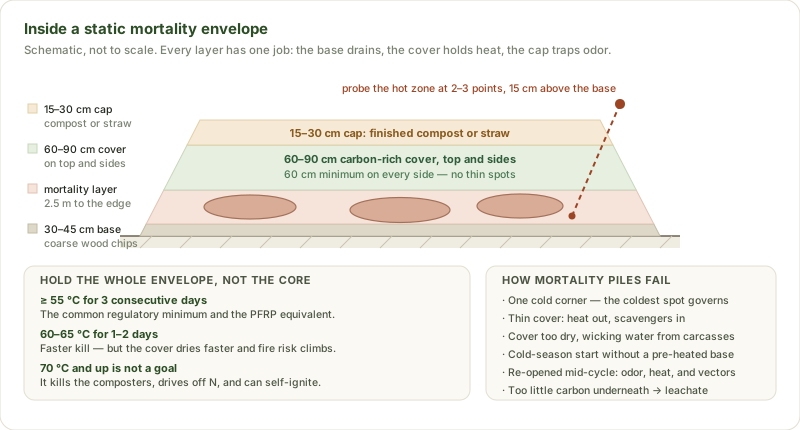
Every livestock farm loses animals; every farm has waste streams that can't go in the normal pile. Composting is the most practical on-farm answer for many of them — but mortality composting is a different discipline: biosecurity first, cover recipe second, and a hard honesty about which disease agents survive.
Why compost mortalities
Why watch it: a short answer from the extension specialists (Cornell and Oklahoma State among them) on the real cost of mortality composting against rendering and incineration — the economics behind the "why" in this section. Watch on YouTube ↗
Rendering pickup has become expensive or unavailable in many regions; burial and incineration face groundwater and air rules; and deadstock haulers are themselves biosecurity connectors between farms. Composting done well keeps the process on-farm, closed-loop, and low-risk: carcasses are 55–70% water plus protein and fat — a dense, nitrogen-rich feedstock that the thermophilic process handles, provided structure and cover are engineered for it. The outputs are heat (sanitation), degraded soft tissue, and mineral bones that can be screened and field-applied where rules allow.
It's a privilege, not a default
Mortality composting is legal for on-farm use in many jurisdictions, prohibited or tightly permitted in others — and rules vary by species, animal weight, cause of death, and disease status. Confirm your state/provincial requirements before the first carcass (see the regulatory map); nothing in this chapter substitutes for them.
The five principles
Cover is everything. The pile is designed around an unbroken envelope of absorbent carbon — typically 45–60 cm (18–24 in) of finished compost or very coarse bulking mix over the carcasses, on a 20–30 cm base layer. The cover insulates (drives core temperature), absorbs leachate, blocks odor and scavengers, and visually proves containment.
Structure, not turning. Mortality piles are static. Turning would expose tissue, aerosolize bioaerosols, and spread material around the pad. Aeration comes from a generous carbon skeleton: coarse chips or straw at roughly 1–2 parts bulking agent per part carcass by volume, more for large animals.
Two-phase thinking. Soft tissue decomposes in weeks-to-months under the cover; bones and large joints need a second phase — either a longer rest in place or a turn-into-second-pile at 3–6 months — before screening and land application.
Core heat is the sanitation engine. Target the same thermophilic band as any hot pile (≥55 °C sustained). A mortality pile that never heats is a burial site with extra steps — diagnose like any cold pile (see pile won't heat).
Biosecurity outranks composting speed. The site, the traffic, and the equipment that touch the pile are managed as a contamination zone — because they are one (see biosecurity).
Systems: bin, static envelope, windrow
Why watch it: the emergency large-scale case done to protocol — envelope construction, layering and cover on a depopulation scale. Watch it for the geometry and the biosecurity discipline, not as a routine farm method. Watch on YouTube ↗
System
Best for
Design essentials
Three-bin composter
Poultry & small hog/sheep farms; routine losses
Bin 1.2–1.8 m high with one open face, roofed if possible; fill bin 1 (base → carcass → cover), move to bin 2 after primary phase, finish in bin 3; sizing ≈ 0.4–0.6 m³ per kg of average daily mortality for continuous flow
Static envelope pile
Cattle & large animals; episodic losses
20–30 cm carbon base, carcass placed on its sternum with abdomen opened/speared (gas release without exposure), body cavities packed with carbon, then the full 45–60 cm cover; one carcass-layer per pile; rest in place 4–12+ months by size
Windrow (covered, static)
High-volume routine mortality (layer operations, feedlots) where legal
Continuous or batched windrow: carbon base 30+ cm, mortality layer, full carbon cover; built in sequence so each section finishes on its own clock; only for sites with pad, water control, and distance from neighbors
Regulator-directed windrow-in-barn or field envelopes at very large scale; performed under official biosecurity protocols — see rules
The recipe in one lineBase of coarse carbon → carcass (cavities opened & packed) → 45–60 cm finished-compost cover → walk away. Moisture of the envelope like any pile (50–60%); no fresh-N additions needed — the carcass is the green.
Four layers, one thermometer. The base drains, the cover holds heat, the cap holds odor — and the cold corner, not the hot core, decides whether the batch is sanitized. Hold 55 °C for three consecutive days and then re-cover and let the envelope heat a second time; the second cycle is your margin for the parts of the pile the probe never saw.
Species notes & timelines
Species / size
Typical primary phase
Total incl. bones
Notes
Poultry (broilers, layers)
2–4 weeks
6–10 weeks
Bin systems shine; litter doubles as carbon; feathers mat — mix through carbon
Swine (nursery–finisher)
4–8 weeks
3–6 months
Teeth/hooves persist; open abdominal cavity & pack carbon
Sheep / goats
4–8 weeks
3–6 months
Wool slows wetting of cover — keep envelope moist in dry spells
Cattle — calves up to ~150 kg
6–10 weeks
4–8 months
Envelope pile or bin if routine
Cattle — mature cows/bulls
4–6+ months
9–18 months
Consider ventral opening & rumen packing; hindquarter skeleton dominates residue; some jurisdictions cap weight per pile or require splitting
Stillbirths & afterbirth: ideal mortality-pile feedstock; handle the same day, cover immediately.
Euthanized animals: sodium pentobarbital residues persist in tissue and can leave detectable residues in finished compost — check drug class with your vet and local rules; many programs exclude chemically euthanized animals from land-applied product.
Winter: build larger, pre-heat the base with fresh manure/bedding where possible, and expect a slow start; the envelope's insulation is the system's cold-weather advantage (see cold-weather operations).
Disease agents: what heat does and doesn't kill
This is where optimism kills flocks and herds. Composting at sustained 55–65 °C destroys most vegetative pathogens — the same time–temperature logic as sanitation testing — but the mortality context raises the stakes on the survivors:
Agent class
Fate in mortality composting
Implication
Common bacteria & viruses (E. coli, Salmonella, IBR, PRRS-type viruses)
Destroyed by sustained core heat when the whole mass reaches temperature
The standard process works — verify with pile temperatures, not hope
Suspected anthrax is a stop sign: no opening the carcass, no routine composting; call authorities
Prions (scrapie, chronic wasting disease, BSE)
Survive composting, rendering, and incineration at ordinary temperatures
Known CWD/scrapie/TSE cases are excluded from mortality composting in most programs; follow regulator routes
Resistant poultry viruses (e.g., some avian influenza/ND scenarios during mass events)
Heat inactivation is the basis of approved emergency protocols, but leakage/cold spots are the failure mode
Regulator-supervised protocol design: envelope integrity, whole-mass temperature, dwell time
Parasites (larvae, ova)
Largely destroyed at thermophilic temperatures
Some ova (e.g., Taenia-type) are hardier — rotate final-use away from susceptible stock if in doubt
The diagnostic rule
Compost the routine deaths you understand; escalate the unexpected, reportable, or mass ones. A sudden spike in mortality is information before it is feedstock — diagnose with your vet first, compost second.
Biosecurity & siting
Location: downslope and downwind of the operation, ≥100 m from wells, watercourses, and property lines (verify local setback — many rules exceed this), on the all-weather pad geometry described in pad design, outside the floodplain, away from traffic that feeds the herd or ships product.
Dedicated tools: loader bucket, probes, and covers that touch mortality material don't re-enter the normal compost flow without cleaning and disinfection — same discipline as the boundary rule, applied harder.
Traffic control: one route in, signage, locked gate where wildlife or scavengers are a real risk; the envelope is scavenger-proof when intact — inspect after storms.
PPE & people: gloves, boots, and coveralls dedicated to the task; wash before re-entering animal areas (zoonotic exposure is the occupational risk here — see occupational safety).
Predators & vectors: intact cover defeats coyotes, dogs, birds, and flies; any breach — a hole, a slumped corner, a smell — is repaired the day it's found with fresh carbon.
Rules, setbacks & emergency events
Permission structure varies: on-farm mortality composting is exempt-from-permit at small scale in many US states and Canadian provinces (with species/weight limits and setback schedules), conditional in others, and prohibited for some causes of death everywhere. Get the current written rule for your jurisdiction — it changes.
Record keeping: date, species/weight, cause of death (if known), pile ID, and temperature log. Records convert an incident from "what happened?" to "here's the file" — the same habit as the batch traceability for product.
Emergency depopulation (e.g., avian influenza): composting is an officially approved carcass-disposal method in several national response programs precisely because it contains and destroys the virus on-site — but it is executed under authority-directed protocols (barn-close windrows, extended envelope designs, strict movement control). Farms don't improvise this; responders do.
End use: composted mortality product is typically legal for on-farm land application after full phase completion (bones screened or left), not for sale, and not on ground that grows feed for other farms without checking rules. When in doubt, apply it to the farm's own non-sensitive ground.
Other specialty streams
Placenta & surgical waste: routine envelope piles handle these easily; same cover discipline.
Hatchery waste & dead chicks at scale: high-moisture, high-N — blend 1:1–2 with carbon as for any wet green; vectors are the constraint (see vector management).
Manure with quarantine/medication status: composting in a dedicated managed pile (not the normal flow) with full thermophilic documentation is the standard on-farm risk-reduction step; withdrawal and residue rules still apply.
Contaminated bedding (spill, chemical, mycotoxin loads): composting degrades many biological contaminants but concentrates heavy metals and persistent chemicals (see what never to compost) — compost the biological risk, exclude the chemical one.
Pet & small-animal carcasses from non-farm sources: treat as mortality feedstock only if rules allow accepting off-farm animals; carnivore remains raise the same zoonotic parasite cautions as in the refusal list.
Troubleshooting
Why watch it: the cold-weather answer in under ten minutes — what changes below freezing, what to pre-build in autumn, and why a winter envelope still has to hit the hold times. Read alongside the cold-weather section of Climate & Seasonal Operations. Watch on YouTube ↗
Symptom
Likely cause
Fix
Odor from the pile
Cover too thin or breached; wet envelope collapsed
Add 15–30 cm dry carbon immediately; rebuild envelope; inspect weekly
Core never reaches 55 °C
Too dry, too little carbon-N contact, winter start, pile too small
Wet the envelope at rebuild points; enlarge pile; pre-heat base in cold weather (diagnose as in won't heat)
Scavenger damage
Cover breach
Repair same day; fence or roof if repeated; never leave carcass uncovered overnight during build
Fly emergence
Adults reached tissue during build
Thicker cover at build time; keep base+cover staged and ready before the carcass is placed
Bones intact at month 6+
Normal for large animals
Second-phase pile or extend rest; screen out and either re-compost or crush/land-apply where rules permit
Leachate stains around pile
Base layer insufficient; pad slope wrong
Rebuild with 30 cm base; correct pad to collection (see pad design)
Key takeaway
Mortality composting is 80% envelope management and 20% patience: build the carbon envelope right, keep it intact and moist, let time and thermophilic heat do the rest — and treat reportable disease as a regulator conversation, never a composting opportunity.