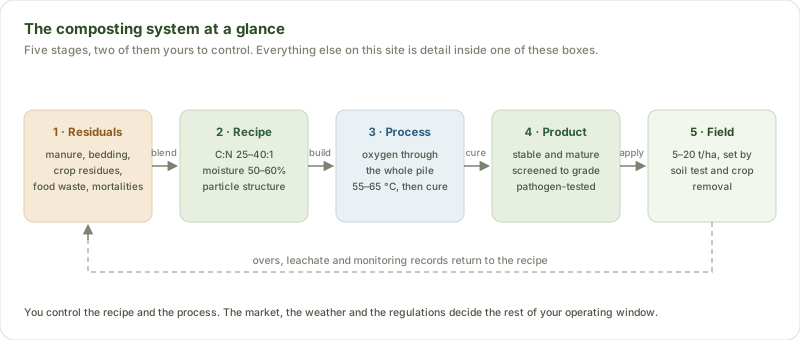
Why composting matters in agriculture
Farms are simultaneously generators and consumers of organic residuals — manure, bedding, crop residues, culls, and spoiled feed. Left raw, these materials are liabilities: nutrient losses to waterways, odor complaints, pathogen risks, and a steady stream of greenhouse gases. Composting converts them into the most broadly useful soil amendment in agriculture: a stabilized, humus-rich material that feeds crops slowly, builds structure and water-holding capacity, suppresses soil-borne disease, and displaces synthetic fertilizer.
Unlike raw manure, compost is stable, largely odor-free, easy to handle, and legally cleaner to apply near sensitive areas. Unlike synthetic fertilizer, it carries organic matter, a living microbiome, and a slow-release nutrient profile. It is one of the few practices that improves nearly every soil property at once — chemical, physical, and biological.
The knowledgebase
The Science
Microbiology, the four process phases, C:N chemistry, heat, and the biology of humus formation.
- Bacteria, fungi & actinomycetes
- Time–temperature curve
- Carbon & nitrogen dynamics
Feedstocks & Recipes
Browns and greens, manures, crop residues, and the interactive C:N mix calculator.
- Properties of 20+ materials
- Bulking agents
- Recipe calculator tool
Methods & Systems
Windrows, aerated static piles, in-vessel, vermicompost, bokashi, and on-farm hybrids.
- Comparison matrix
- Choosing a system by scale
- Infrastructure & siting
Process Control
Monitoring and managing temperature, moisture, aeration, pH, and turning schedules.
- Reading a temperature curve
- Troubleshooting matrix
- Record keeping
Quality & Standards
Maturity vs stability, pathogen reduction, contaminants, US EPA 503 / NOP / EU rules.
- Lab tests explained
- Sampling correctly
- Reading a compost analysis
Field Application
Rates, timing, placement, and integration across cropping and grazing systems.
- Rate calculation
- Compost in rotations
- Specialty crops & pasture
Soil & Agronomic Benefits
Structure, water, nutrients, disease suppression, yield responses, and the research.
- Soil health mechanisms
- Nutrient release curves
- Yield meta-analyses
Environmental Impact
Greenhouse gases, nutrient runoff, leachate, odors, and mitigation strategies.
- CH₄ and N₂O control
- Water protection
- Carbon accounting
Economics & Logistics
Costs, markets, regulations, equipment, and business models for farm composting.
- Cost breakdowns
- Value & pricing
- Equipment selection
Also in the almanac
Compost Tea & Liquid Extracts
Aerated vs non-aerated brewing, recipes, rates, food safety, and the research — in a printable format.
🧺Screening, Finishing & Storage
Curing biology, screen sizes and overs recycling, blending grades, stockpile covers, and pre-sale quality checks.
❓The FAQ
Thirty common questions, answered and cross-linked to the full chapters. Prints to a field copy.
🛠️Troubleshooting
The 90-second diagnostic: pile won't heat, odors, pests, wet/dry, fires, and stuck compost.
📚Resources
Handbooks, standards, organizations, and research themes to go deeper.
📋Reference Tables
Conversions, target ranges, sanitation thresholds, rates, analysis values and limits — the almanac's numbers on one printable page.
Deep dives
Vermicomposting
Worm biology, systems from bin to flow-through, feeding, harvesting, and product quality.
🦴Mortality & Specialty Waste
Carcass composting systems, biosecurity envelopes, disease-agent limits, and the regulatory picture.
⚫Biochar & Compost
Pyrolysis, charging, co-composting, and the honest evidence for soil and climate.
⚗️Additives & Inoculants
Starters, EM, humics, gypsum, zeolite, rock dust — the additive aisle sorted by strength of evidence.
🌦️Climate & Seasonal Operations
Winter, arid, monsoon, and tropical playbooks plus the seasonal operations calendar.
🌍Soil Carbon & Climate
Where compost carbon goes, how to measure it, and where credits actually pay.
🛡️Safety & Regulations
Bioaerosols, machinery, food-safety rules, FSMA, and the regulatory map.
💧Water & Leachate
The pile water balance, leachate chemistry, pad design, treatment & reuse.
📐Visual Guide
SVG diagrams: windrow geometry, ASP layout, turning patterns, water flow.
🧭Interactive Diagnoser
Answer six questions; get a likely cause and fix for your stuck pile.
Quick answers
How long does composting take?
What's the ideal pile recipe?
Why did my pile stop heating?
Is compost "organic"?
Can I compost meat, dairy, and diseased plants?
How much compost should I apply per acre?
The Compost Almanac is an independent educational reference. Figures are drawn from peer-reviewed literature and public agency guidance (USDA-NRCS, US EPA, US Composting Council); always verify regulatory details with your local authority. Content is provided for educational purposes and is not regulatory or agronomic advice for a specific operation.